
Published: November 19, 2026. Last updated: November 22, 2026.
A PayPal negative balance means your account shows an amount below zero that PayPal considers money you owe. This can happen when a bank payment fails, a buyer receives a refund, a chargeback reverses a seller payment, or another transaction creates a liability larger than your available balance.
To resolve it, sign in to PayPal, review your recent Activity to identify the cause, and select Resolve Negative Balance. You can then choose an available funding method and add money toward the amount owed. If you believe the balance resulted from unauthorized activity or an error, review and report the transaction promptly.
Leaving a negative balance unresolved can lead to account restrictions and potentially debt collection. This guide explains how to identify and resolve the problem, what happens to incoming payments, and what to do if you cannot pay or believe the amount is incorrect.
This guide covers U.S. PayPal accounts and reflects PayPal’s published Help Center guidance and U.S. User Agreement, last updated November 4, 2026.
What does a negative PayPal balance mean?
A negative balance means PayPal has recorded an outstanding amount against your account. Under the PayPal U.S. User Agreement, a negative account balance represents an amount owed to PayPal.
For example, if your balance shows -$75.00, your account is $75 below zero. If the underlying transactions are valid, you need to bring that amount back to zero.
A negative PayPal balance is not necessarily the same as a bank overdraft. It also differs from an outstanding PayPal Credit loan, a Pay Later installment obligation, or a temporary payment hold.
A payment hold makes certain money temporarily unavailable. A negative balance means deductions or other recorded liabilities have exceeded the funds available to cover them. An account may have a hold without having a negative balance.
Why is your PayPal balance negative?
PayPal identifies several situations that can cause an account balance to fall below zero. The reason may involve a payment you made, a payment you received, or a later adjustment to an earlier transaction.
| Possible cause | What happened | What to check |
|---|---|---|
| Failed bank payment | Your bank did not complete a payment PayPal had attempted to process. | Bank statement, returned payment, and PayPal Activity |
| Buyer dispute | Funds connected to a disputed sale were held or deducted. | Resolution Center and transaction status |
| Card chargeback | A buyer challenged the payment through their card issuer. | Chargeback notice and merchant transaction details |
| Refund or reversal | Money was returned to a buyer or an earlier payment was reversed. | Refund records and payment adjustments |
| Ineligible seller transaction | PayPal reversed a payment that was not protected under the applicable Seller Protection conditions. | Seller Protection eligibility and case decision |
| Unauthorized activity | Someone may have used your account without your permission. | Unrecognized transactions and security notifications |
A payment from your bank account failed
One common cause is a bank-funded payment that PayPal initially processes but your bank later rejects.
Bank payments do not always clear immediately. PayPal explains that certain bank-funded transactions take approximately two to five business days to clear. During this period, a payment may appear to have gone through even though the bank has not completed its part of the transaction.
If the bank returns the payment and the funding cannot be recovered through another available method, your PayPal balance can become negative.
Common reasons include insufficient bank funds, a closed bank account, incorrect bank details, or technical problems at the bank.
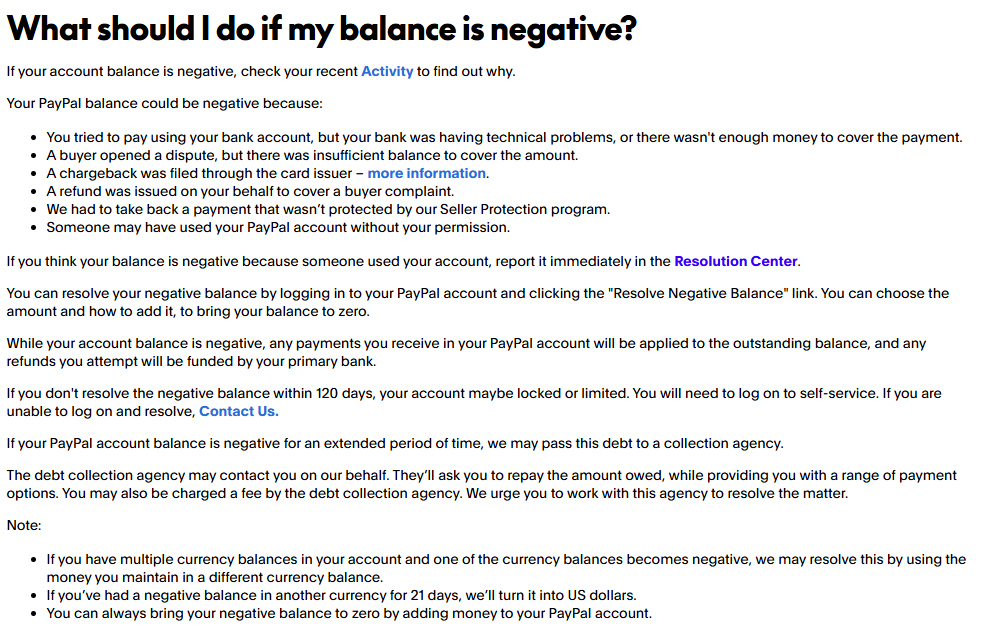
Your bank may also impose its own returned-payment charge. Check the bank’s records and PayPal’s returned bank payment guidance to determine why the original payment failed.
A buyer opened a dispute or chargeback
If you sell goods or services through PayPal, a buyer dispute may affect the money you previously received.
PayPal may temporarily hold funds while investigating a dispute. If the payment is ultimately reversed, the money can be removed from your balance. When your available funds are insufficient to cover the deduction, the account may become negative.
A chargeback is different from an ordinary PayPal dispute. It occurs when the buyer challenges a card-funded payment through their card issuer. PayPal may deduct the disputed amount and any applicable fees, subject to the transaction’s conditions.
Opening a dispute does not always create a debt. Review the case to determine whether funds are only on hold or have actually been reversed.
A refund or payment reversal exceeded your available funds
Suppose you receive $100 for a sale and later transfer most of that money out of PayPal. If the transaction is subsequently reversed and the full amount becomes payable, the remaining balance may not be enough to cover the deduction.
The same issue can arise when PayPal refunds a buyer after resolving a complaint or invalidates a payment that is not protected under its Seller Protection Program.
The relevant transaction record should identify the refund, adjustment, or reversal. Sellers can also review PayPal’s Seller Protection terms to understand whether a disputed transaction may qualify for protection.
How to find out why your PayPal balance is negative
Before adding money, review the account history to identify the transaction that caused the negative amount. This is particularly important if the balance changed unexpectedly or you believe the deduction is incorrect.
- Sign in to PayPal. Open PayPal’s official website or the PayPal app.
- Check your balance. Review the amount shown on your Dashboard. For currency-specific details, open Wallet.
- Open Activity. Look for recently completed payments, bank transfers, refunds, reversals, and other adjustments.
- Review relevant transactions. Open the details of any payment that could explain the negative amount.
- Check the Resolution Center. Look for open or recently closed buyer disputes, chargebacks, account notices, or other unresolved issues.
- Compare the amounts. Check whether the transaction deductions and available balance explain the displayed negative figure.
If you cannot identify the cause, contact PayPal Customer Support and request an explanation of the balance and associated transactions.
Keep records of any payment you believe was charged twice, already repaid, or reversed incorrectly. If the amount resulted from suspected unauthorized activity, report the suspicious transaction immediately rather than waiting for an ordinary balance inquiry to conclude.
How to resolve a negative PayPal balance
PayPal provides a dedicated option for bringing a negative balance back toward zero. The available funding methods depend on your account and the payment options PayPal offers during the process.
- Log in to PayPal. Open your account using the official website.
- Select Resolve Negative Balance. Find the Resolve Negative Balance link associated with your outstanding amount.
- Review the amount owed. Check the balance and confirm the amount you intend to add.
- Choose a funding option. Select one of the eligible methods displayed by PayPal.
- Complete the payment. Follow the instructions to review and submit the amount.
- Check the updated balance. Review Activity and your account balance to confirm when the funds have been applied.
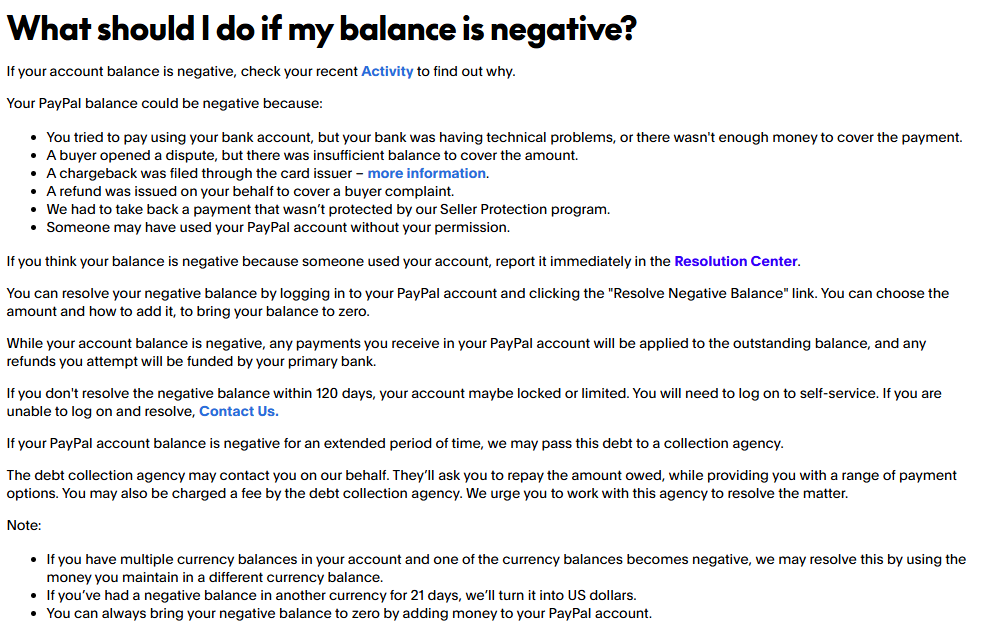
PayPal lets you choose the amount and available method when resolving a negative balance. If you add less than the total owed, the remaining amount can stay negative until it is covered.
The process is explained in PayPal’s official negative balance instructions.
Add money from a linked bank account
If your account offers bank funding, you can use an eligible confirmed bank account to add money toward the outstanding balance.
For ordinary transfers into a PayPal balance, PayPal states that money added from a bank generally takes up to five business days to become available. Some eligible bank transfers may be offered with faster processing.
A standard balance transfer on the PayPal website begins in Wallet, under Transfer Money, followed by Add money from your bank or debit card. However, when an account is negative, use the dedicated Resolve Negative Balance process and the funding methods it displays.
Bank processing time can mean the negative balance does not clear immediately. Check the pending transfer in Activity before attempting another payment, and ensure the bank has enough available funds to complete the transfer.
See PayPal’s bank funding timing guidance.
Use an eligible debit card
PayPal also supports adding money to eligible personal balances using linked Visa or Mastercard debit cards.
General debit card balance funding often completes within seconds, although actual processing depends on eligibility and account conditions.
If PayPal offers a debit card within your negative balance resolution options, review the displayed instructions and submit the amount using that method.
Not every method available for ordinary balance funding is necessarily available for resolving a negative balance. Check the specific options shown in your account rather than assuming a particular bank account, debit card, or credit card can always be used.
What if PayPal will not let you add money?
If a payment fails or the funding option you expected does not appear, check whether your selected bank or card is eligible, active, and correctly linked.
A returned bank payment can temporarily prevent another bank-funded transaction from being approved until the underlying issue is resolved. An account limitation can also restrict which features are available.
Review PayPal notifications and any information in the Resolution Center. If your account is restricted or the Resolve Negative Balance option is unavailable, contact PayPal support through its official website to ask how the outstanding amount can be addressed.
What happens if someone sends you money while your balance is negative?
Money received into an account with a negative balance is generally applied toward the amount owed. PayPal explains that incoming payments can reduce the negative balance rather than becoming fully available for spending or withdrawal.
For example, suppose your account shows a balance of -$75 and you receive an eligible $25 payment. Assuming no other charges or adjustments, the balance would decrease to -$50.
If you later receive another $60, that payment could cover the remaining $50 debt and leave $10, assuming there are no additional deductions or fees.
This is particularly important for sellers and freelancers who rely on PayPal to receive customer payments. An incoming payment may be used to satisfy an outstanding balance before the funds are available for other purposes.
PayPal also states that refund transactions attempted while a balance is negative may be funded through the account’s primary bank. Merchants should therefore review their funding arrangements before issuing additional refunds.
Can PayPal recover a negative balance from other accounts or payment methods?
PayPal’s U.S. User Agreement gives it certain rights to recover amounts owed through funds associated with the account and other permitted payment arrangements.
PayPal may deduct an outstanding negative amount from money later added to the account or received from another user. If the same account holder has more than one PayPal account, PayPal may also offset a negative amount against funds in another eligible PayPal account.
The agreement also authorizes PayPal to charge linked payment methods in specified circumstances, including amounts owed to PayPal.
These provisions do not mean that PayPal automatically charges every linked card or bank account in every case. What happens depends on the applicable agreement, existing authorizations, and circumstances surrounding the debt.
Negative balances in different currencies
If your PayPal account holds balances in multiple currencies, PayPal may use money held in one currency to offset an outstanding negative amount in another.
Under the U.S. User Agreement, a negative balance in a currency other than U.S. dollars that remains outstanding for 21 days or longer will be converted into U.S. dollars.
Currency conversion uses PayPal’s transaction exchange rate, including the applicable currency conversion spread. This can affect the dollar amount required to resolve the balance.
The relevant terms appear under Amounts owed to PayPal in the U.S. User Agreement.
What happens if you do not pay your negative PayPal balance?
Leaving a valid negative balance unresolved can lead to restrictions on your account and possible efforts to recover the outstanding amount.
PayPal’s U.S. Help Center states that an account with a negative balance unresolved for 120 days may become locked or limited.
This is not a guarantee that every account will be restricted on exactly the 120th day. PayPal can also apply other restrictions based on account activity, risk, or the applicable agreement.
An account limitation may prevent certain actions, such as sending or withdrawing money. PayPal can require additional information or specific steps before restoring access.
If the outstanding amount remains unresolved for an extended period, PayPal may refer the debt to a collection agency. The agency may then contact you about repayment, and any additional charges must be considered under applicable terms and law.
The 120-day account restriction guidance is separate from debt collection procedures. It is not a universal deadline that automatically sends every negative balance to collections.
PayPal describes these potential consequences in its negative balance guidance and account limitation documentation.
Does a negative PayPal balance affect your credit score?
A negative PayPal balance does not automatically establish that the amount has been reported to a credit bureau or has affected your credit score.
There is a difference between owing money to PayPal, having an unpaid amount referred to a collection agency, and having an account reported to a consumer credit reporting company.
PayPal states that unresolved negative balances may be referred for collection. However, this does not mean every account is reported to Equifax, Experian, or TransUnion.
If a collection account is reported to a credit reporting company, it may affect your credit history and potentially your credit score. The actual impact depends on the reported information and the credit scoring model.
The Consumer Financial Protection Bureau explains that debt collectors must follow specified contact and reporting requirements before reporting a debt to a consumer credit reporting company.
If you are concerned about a possible collection entry, review your credit reports for accuracy. You can obtain your reports through AnnualCreditReport.com, the federally authorized source for free credit reports.
Paying an outstanding amount does not necessarily mean that a previously reported collection entry will disappear immediately. If information is inaccurate, you can dispute it with the reporting company and the organization that furnished it.
What if you cannot afford to repay the balance immediately?
If you cannot cover the outstanding amount immediately, start by confirming the balance and identifying the transactions responsible. This ensures you understand what PayPal is asking you to repay.
You can review the available options in the Resolve Negative Balance process and contact PayPal support to explain your circumstances.
Useful steps include:
- Confirm the amount owed. Compare the displayed balance with recent transactions, reversals, and refunds.
- Review available funding methods. Check whether the account permits you to add part or all of the outstanding amount.
- Contact PayPal. Ask which payment options or assistance arrangements, if any, are available for your account.
- Monitor account messages. Review notices about restrictions, repayments, or collection activity.
- Keep payment records. Save details of completed transfers and communications so you can identify any amount that has already been paid.
PayPal does not guarantee installment arrangements, extensions, or debt forgiveness for every negative balance. Any assistance depends on the account’s circumstances and the options PayPal makes available.
If you believe the balance is incorrect, explain the disputed transactions when contacting PayPal. An inquiry about a potentially incorrect amount should be distinguished from simply refusing to address a valid outstanding debt.
What if your negative PayPal balance is incorrect?
If the amount does not match your transaction history, investigate the underlying activity before assuming every deduction is correct.
Possible problems include a payment recorded twice, a refund already accounted for, a disputed reversal, an incorrect currency calculation, or activity you did not authorize.
- Review Activity. Locate the transactions that appear to account for the negative amount.
- Compare your records. Check bank statements, refund confirmations, and payment receipts.
- Check disputes and chargebacks. If the amount relates to a seller case, open the Resolution Center to review the decision and available response options.
- Contact PayPal. Explain the discrepancy and provide relevant transaction information.
- Retain correspondence. Keep copies of documents and account updates connected to the inquiry.
If PayPal made a correction or a transaction was reversed, the account balance may change once the adjustment is completed. Do not assume that a payment dispute or balance inquiry automatically suspends every other account obligation.
Negative balance caused by unauthorized activity
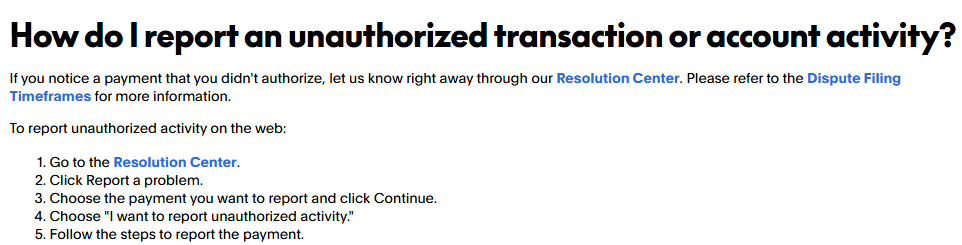
If someone may have accessed your account and sent money without permission, report the suspected unauthorized transaction immediately.
- Sign in to PayPal and open the Resolution Center.
- Click Report a problem.
- Choose the suspicious payment and click Continue.
- Select I want to report unauthorized activity.
- Follow the instructions to submit the report.
Secure the account as well by changing your password, checking linked payment methods, and enabling two-step verification where available.
PayPal investigates unauthorized transaction reports under the applicable account protections. Reporting suspected fraud does not automatically remove a negative balance before the relevant review and adjustments are completed.
See PayPal’s unauthorized activity reporting instructions for the current procedure.
What should sellers do when a dispute causes a negative balance?
For a seller, the underlying dispute may determine whether an amount is ultimately owed. Review the case rather than treating every temporary hold as a final loss.
Open the Resolution Center to identify the transaction and the buyer’s complaint. PayPal may request supporting evidence, such as shipping records, delivery confirmation, or documentation showing that digital goods or services were provided.
Seller Protection can apply to certain eligible Unauthorized Transaction and Item Not Received claims. However, protection is conditional and depends on the transaction, dispute category, and evidence.
If PayPal decides that a payment must be reversed and the account lacks sufficient funds, the resulting deduction can create or increase a negative balance. Applicable dispute or chargeback fees may also affect the total amount.
Check the specific case and the official Seller Protection Program before determining your available options. The dispute response deadlines displayed in the case should be followed promptly.
Can you close a PayPal account with a negative balance?
No. PayPal’s U.S. User Agreement states that an account generally cannot be closed while it has a negative balance, an open dispute or claim, a pending transaction, or certain account holds and limitations.
To close an account, the outstanding balance and applicable unresolved issues must first be addressed.
Closing an account does not eliminate obligations that arose before closure. PayPal’s agreement states that users remain responsible for applicable account obligations even after an account is closed.
Opening another PayPal account to bypass an existing negative balance or account restriction can also violate PayPal’s rules.
For the closure requirements, see PayPal’s official account closure guidance.
What if a collection agency contacts you about your PayPal balance?
If a negative balance remains unresolved, PayPal may eventually refer the debt to a collection agency. A collector contacting you about the amount should be able to identify the agency and provide information about the debt.
Before paying someone who claims to be collecting for PayPal, verify that the communication is legitimate. Fraudsters sometimes impersonate debt collectors to obtain money or personal information.
- Ask for the collection agency’s name, mailing address, and contact information.
- Request information identifying PayPal as the creditor and explaining the amount owed.
- Compare the claimed debt with your PayPal Activity and previous payment records.
- Contact PayPal through its official website if you need to verify the collection arrangement.
- Keep copies of collection notices, payment confirmations, and correspondence.
Under federal debt collection rules, a covered debt collector generally must provide validation information about the debt. This includes the creditor, the amount claimed, and information about your ability to dispute it.
If you dispute all or part of the debt in writing within the applicable 30-day validation period, the collector generally must stop collecting the disputed amount until it provides the required verification.
These protections and the information a collector must provide are explained by the Consumer Financial Protection Bureau.
You can also review the CFPB’s guidance on identifying legitimate debt collectors. Do not share sensitive financial credentials or send money through an unfamiliar payment method merely because a caller claims to represent PayPal.
How to prevent another negative PayPal balance
Not every negative balance can be prevented, especially when a transaction is disputed or reversed unexpectedly. However, several account management practices can reduce avoidable payment failures and make problems easier to investigate.
- Check bank funds before paying. Make sure your linked bank account can cover PayPal payments that may take several days to clear.
- Keep bank details current. Update or remove closed or inaccurate accounts to reduce rejected transfers.
- Monitor payment activity. Review account changes, refunds, returned payments, and reversals regularly.
- Manage seller disputes promptly. Respond to buyer complaints and retain the shipping or fulfillment evidence required for eligible transactions.
- Allow for potential refunds. If you operate a business, consider refund and chargeback liabilities when deciding how much money to withdraw from PayPal.
- Protect your account. Use a unique password, enable two-step verification, and review unfamiliar account activity promptly.
Frequently asked questions
Can you still receive payments with a negative PayPal balance?
You may still receive payments if your account remains eligible to accept them. However, PayPal generally applies incoming money toward the outstanding negative balance. Separate account limitations may restrict payment activity.
Can you send money with a negative PayPal balance?
Your ability to send money depends on the account’s status, available payment methods, and applicable restrictions. PayPal’s agreement allows it to combine an outstanding negative amount with a new transaction when the combined amount is disclosed before that transaction is initiated. A restricted account may not be able to send payments.
How long does it take to clear a negative PayPal balance?
The timing depends on how the funds are added and processed. A normal linked bank transfer into a PayPal balance may take up to five business days, while eligible debit card funding can be faster. Account-specific negative balance repayment options and processing times may differ.
Does PayPal charge interest on negative balances?
A negative PayPal balance is an amount owed under the account agreement, not automatically a PayPal Credit loan. PayPal’s negative balance guidance does not establish one universal interest or penalty schedule for every case. The underlying transactions may involve applicable dispute or other charges, and a collection agency may impose permitted fees. Review the specific account records and applicable terms for the amount being claimed.
Will paying the negative balance restore your PayPal account?
Resolving the outstanding amount addresses the negative balance. However, if PayPal has imposed a separate security, compliance, or risk-related limitation, that restriction may remain until the additional requirements have been satisfied. Review account notifications and the Resolution Center for any remaining actions.
Resolving your PayPal negative balance
A negative PayPal balance usually results from a failed bank payment, refund, chargeback, dispute-related deduction, or another reversed transaction. The appropriate response begins with identifying the cause and confirming the amount shown in your account.
For a valid outstanding amount, PayPal provides the Resolve Negative Balance option and displays the available methods for adding funds. Payments received later may also be applied toward the debt.
If the balance appears incorrect or results from suspected unauthorized activity, review the transaction and contact PayPal promptly. Unresolved negative balances can lead to account limitations or possible collection activity, but those outcomes are not automatic in every case.
For account-specific instructions, consult PayPal’s negative balance guidance and the U.S. User Agreement. If a third-party collection agency is involved, the CFPB’s debt collection resources explain relevant consumer protections.