
Published: November 4, 2026. Last updated: November 22, 2026.
PayPal Seller Protection helps eligible sellers avoid losing money when a buyer reports an unauthorized payment or claims an order never arrived. If a transaction qualifies and the seller meets PayPal’s requirements, the program may allow the seller to keep the full purchase amount despite an eligible claim, chargeback, or reversal.
Protection is not guaranteed for every transaction. Sellers must meet eligibility rules, retain acceptable evidence, and respond to disputes within the required deadlines. Claims that an item was significantly different from its description and Item Not Received chargebacks filed directly with a card issuer are not covered.
This guide explains PayPal protection for sellers in the United States, including qualifying transactions, shipping documentation, digital products, exclusions, and how to respond when a customer disputes a payment.
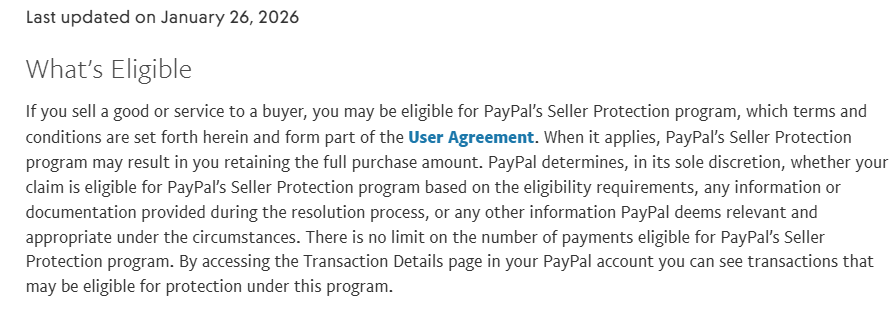
PayPal’s U.S. Seller Protection Program was last updated on January 26, 2026. Eligibility depends on the terms applicable to the transaction and PayPal’s review of the evidence.
What does PayPal Seller Protection cover?
PayPal Seller Protection primarily addresses two categories of payment problems: Unauthorized Transactions and Item Not Received claims. The type of complaint and the channel through which the buyer files it are important because they determine whether the transaction can qualify.
| Claim type | Seller Protection coverage | Important condition |
|---|---|---|
| Unauthorized Transaction | Potentially covered | Payment eligibility, valid fulfillment evidence, and other applicable requirements |
| Item Not Received through PayPal | Potentially covered | Valid proof of delivery and compliance with program requirements |
| Item Not Received chargeback through card issuer | Not covered | Excluded from PayPal Seller Protection |
| Significantly Not as Described | Not covered | Excluded whether raised through PayPal or the card issuer |
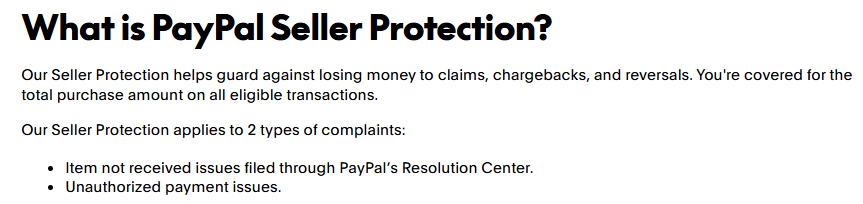
PayPal determines eligibility according to its official U.S. Seller Protection Program, the transaction details, and any information submitted during the dispute process.
Unauthorized Transaction claims
An Unauthorized Transaction claim occurs when an account holder reports that they did not authorize or benefit from a payment made from their PayPal account.
For example, a seller might receive payment for a product, ship the order, and later learn that the account holder disputes authorizing the purchase. Seller Protection may apply if the payment and fulfillment meet the program’s requirements.
For eligible physical goods, PayPal generally requires valid proof of shipment or delivery. The transaction must also be marked Eligible or Partially Eligible for Seller Protection on the Transaction Details page.
An additional timing requirement applies to Unauthorized Transaction claims: the evidence must demonstrate that the item was shipped or provided no later than two days after PayPal notified the seller of the dispute or reversal.
Protection can also apply to certain unauthorized card-funded chargebacks and bank-funded payment reversals. However, the payment type and all other eligibility conditions still matter.
Item Not Received claims
An Item Not Received claim occurs when a buyer says they paid for an order but never received it.
For physical goods, a seller seeking protection against this claim must provide acceptable proof of delivery. Evidence showing only that a package was dispatched is not sufficient to meet the program’s additional Item Not Received requirement.
The distinction between PayPal and card issuer disputes is essential. Seller Protection may apply when the buyer files an eligible Item Not Received claim through PayPal’s Resolution Center. It does not cover an Item Not Received chargeback the buyer files directly with their card issuer.
PayPal Seller Protection eligibility requirements
A transaction must satisfy the basic program requirements and any additional conditions associated with its payment type or claim category.
- U.S. account: The primary address associated with the seller’s PayPal account must be in the United States for the U.S. program to apply.
- Eligible sale: The transaction must involve eligible goods or services. Certain products, payments, and transaction methods are excluded.
- Correct shipping address: Physical items must be sent to the shipping address shown on the PayPal Transaction Details page, except where an applicable in-person transaction exception applies.
- Acceptable evidence: The seller must provide the shipping, delivery, or digital fulfillment documentation required for the claim.
- Timely responses: Sellers must respond to PayPal’s documentation and information requests within the deadlines provided.
- Compliant payment processing: Business sellers using PayPal Checkout integrations must meet applicable technical and risk-management requirements.
For preorders or made-to-order products, sellers must ship within the timeframe specified in the original listing. For other goods, PayPal recommends shipping within seven days of receiving payment.
The seven-day period is a recommendation for ordinary orders, not a universal replacement for the specific shipping and evidence requirements of the program.
Why the shipping address matters
The address shown in PayPal’s Transaction Details is central to protection for physical goods. Shipping to a different destination can make an otherwise eligible transaction ineligible.
Suppose a buyer pays for an item and then sends a message requesting delivery to another address. Even if the message appears legitimate, shipping to that alternative address may compromise Seller Protection.
PayPal recommends arranging a refund and asking the buyer to make a new payment with the correct delivery address. The same concern applies when a shipment is redirected after initially being sent to the address shown in the transaction.
Checkout integration requirements
Business sellers accepting payments through PayPal Checkout on a website or application must use the current version of the relevant PayPal Checkout product.
Where applicable, integrations must also transmit required session information to PayPal. This information supports PayPal’s assessment of potentially fraudulent transactions. Additional technical requirements may apply to sellers operating in higher-risk business categories.
Using a payment button or accepting a successful transaction does not, by itself, establish that every Seller Protection requirement has been met.
How to check if a PayPal payment is eligible for Seller Protection
PayPal allows sellers to review potential Seller Protection eligibility from the Transaction Details page of a payment.
- Sign in to your PayPal account.
- Open Activity and find the relevant payment.
- Select the payment to open its Transaction Details.
- Review any Seller Protection eligibility information associated with the transaction.
- Confirm the shipping address and retain the records needed to satisfy the applicable requirements.
Depending on the transaction, PayPal may display an eligibility status such as Eligible, Partially Eligible, or Ineligible.
Eligible indicates potential program coverage, subject to all applicable conditions. Partially Eligible indicates more limited potential coverage, with the precise requirements depending on the transaction and claim type. Ineligible indicates that the payment is not eligible for Seller Protection.
For Unauthorized Transaction claims involving physical goods, PayPal’s U.S. terms recognize payments marked Eligible or Partially Eligible. For intangible goods facing an Unauthorized Transaction claim, the rules are stricter: PayPal must have marked the transaction Eligible or otherwise notified the seller of eligibility in writing.
A favorable status does not guarantee a successful outcome. PayPal can request further evidence and evaluates claims against the complete program terms.
Proof of shipment vs. proof of delivery
One of the most important Seller Protection distinctions is the difference between demonstrating that an order was shipped and demonstrating that it was delivered.
| Requirement | Proof of shipment | Proof of delivery |
|---|---|---|
| What it demonstrates | The item was sent to the buyer | The item reached the required destination |
| Tracking information | Verifiable tracking number | Verifiable tracking number |
| Date | Shipment date | Delivery date |
| Delivery status | Not required to establish shipment alone | Delivered status required |
| Recipient address | Must match the PayPal transaction requirements | Must match the PayPal transaction requirements |
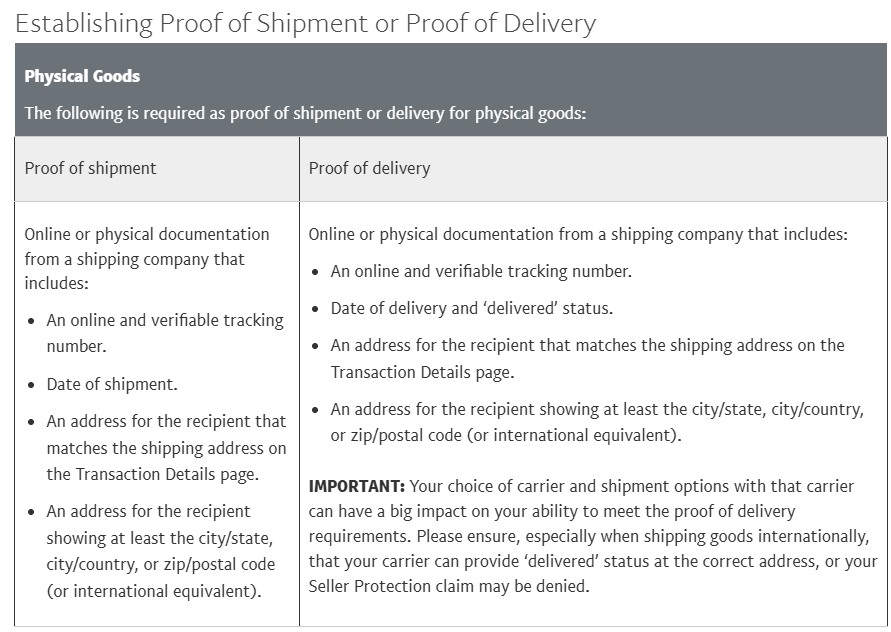
Acceptable proof of shipment
For physical items, PayPal generally requires shipping company documentation containing a verifiable tracking number, the date of shipment, and recipient address information corresponding to the PayPal transaction.
The documentation must identify the recipient’s destination sufficiently to match the address in the Transaction Details page, including relevant city, state, country, or postal code information.
Simply buying a shipping label does not necessarily prove that the carrier accepted or shipped the package. Retain carrier-generated tracking and shipment records rather than relying solely on an order confirmation.
Acceptable proof of delivery
Proof of delivery requires verifiable carrier information showing the delivery date, delivered status, tracking number, and matching recipient address details.
For an Item Not Received claim, PayPal specifically requires valid proof of delivery. Tracking that shows only “label created,” “accepted,” or “in transit” does not establish completed delivery.
Shipping internationally can make this more complicated because some carriers or delivery partners do not consistently provide detailed confirmation of the final destination. Choose a delivery service capable of providing the documentation required by PayPal.
Is signature confirmation required?
PayPal changed its U.S. signature confirmation requirements in January 2026.
For transactions processed before January 26, 2026, PayPal’s guidance required signature confirmation for qualifying payments over $750, or the applicable foreign-currency equivalent.
For transactions processed on or after January 26, 2026, signature confirmation is recommended but is no longer mandatory under the revised U.S. Seller Protection requirements.
Carrier tracking and valid delivery evidence remain important regardless of the signature rule. For valuable shipments, signature confirmation can provide an additional record if a customer later disputes delivery.
These rules are explained in PayPal’s official shipment and digital delivery guidance.
Does PayPal Seller Protection cover digital goods and services?
Yes, certain digital goods and services can qualify for PayPal Seller Protection. However, intangible transactions have additional eligibility and evidence requirements, and not every online service or digital product is automatically protected.
Potentially eligible transactions may involve software, digital downloads, online services, or other intangible products, provided the sale meets the applicable program requirements.
For an Unauthorized Transaction claim involving an intangible product, PayPal requires the payment to be marked Eligible on the Transaction Details page or for the seller to have received written notice of eligibility. The seller must also show that the product or service was provided.
What counts as proof of digital delivery?
PayPal requires compelling evidence showing that the digital item was delivered or that the purchase order was fulfilled.
Depending on the product or service, useful evidence may include:
- Digital delivery records: System logs showing when a download link, license, or digital product was sent to the buyer.
- Recipient identification: Relevant email addresses, IP information, or other records connecting delivery to the intended recipient.
- Access records: Documentation indicating that the buyer received, downloaded, activated, or accessed the digital product.
- Service completion evidence: Records showing that the agreed service was provided, including relevant completion or access information.
- Buyer communications: Messages confirming that the buyer received access, accepted a deliverable, or acknowledged completion.
The appropriate evidence depends on the transaction. A delivery email alone may not settle every dispute, particularly if it does not establish that the product was sent to or accessed by the intended recipient.
Example: A freelance digital service
Consider a freelancer who receives a PayPal payment for a website design project. After completing the work, the freelancer sends the deliverables through an online platform.
If the buyer later disputes receiving the service, relevant documentation might include project delivery records, platform activity showing the files were accessed, and communications confirming completion.
These records can help establish fulfillment, but the transaction must independently meet PayPal’s eligibility conditions. Completion of a service does not guarantee that every resulting claim is covered.
What is not covered by PayPal Seller Protection?
The U.S. Seller Protection Program excludes several payment categories, products, and dispute types. Understanding these exclusions before accepting payment is important because some transactions remain outside the program even when the seller has proof of delivery.
| Excluded category | What sellers should know |
|---|---|
| Significantly Not as Described claims | Seller Protection does not cover complaints that the item or service differs significantly from its description. |
| Item Not Received chargebacks filed with card issuers | These are excluded even though eligible Item Not Received claims filed through PayPal may be covered. |
| Friends and Family payments | Personal transfers are not eligible commercial transactions. |
| Gift cards and cash-equivalent products | Payments equivalent to cash, including prepaid and stored-value cards, are excluded. |
| Real estate, businesses, and financial investments | These categories fall outside the program. |
| Most vehicles and industrial manufacturing machinery | Excluded, subject to specific exceptions for certain personally portable recreational vehicles. |
| Donations and certain crowdfunding payments | Not eligible for Seller Protection. |
| In-person delivery of physical goods | Generally excluded, with a specific exception for eligible in-person PayPal Goods and Services QR code transactions. |
| Prohibited transactions | Items or activities prohibited under PayPal’s User Agreement or Acceptable Use Policy are excluded. |
Additional exclusions apply to gold, certain NFTs, gambling-related transactions, government-related payments, PayPal Payouts, and other specified categories.
For NFTs, PayPal’s U.S. program excludes transactions above $10,000. Transactions of $10,000 or less are also excluded unless the claim concerns an Unauthorized Transaction and all applicable conditions are satisfied.
The complete exclusions are available in PayPal’s Seller Protection Program terms.
Are in-person sales protected?
Physical items delivered directly to a buyer in person are generally not eligible for Seller Protection. However, PayPal provides an exception for qualifying transactions completed in person using a PayPal Goods and Services QR code.
For those transactions, sellers may need to provide alternative evidence of delivery or additional documentation requested by PayPal.
A successful QR code payment does not automatically establish eligibility. The payment method and transaction must satisfy the relevant conditions.
How to respond to a PayPal seller dispute
If a customer opens a dispute, responding promptly and submitting the appropriate documentation can help protect the seller’s position.
PayPal manages buyer-seller disputes and claims through its Resolution Center, where sellers can review cases, communicate with buyers, and provide supporting evidence.
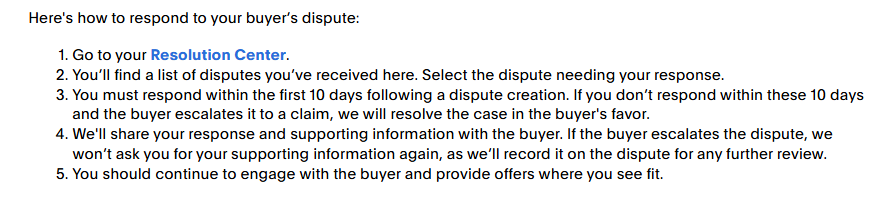
- Open the Resolution Center. Sign in to PayPal and access the list of disputes requiring attention.
- Review the complaint. Select the relevant case and identify whether the issue concerns an unauthorized payment, non-delivery, product description, or another reason.
- Check the transaction details. Review the payment status, shipping address, transaction date, and any Seller Protection eligibility information.
- Submit relevant evidence. Upload carrier tracking, delivery confirmation, digital fulfillment records, refund documentation, or other information requested for the claim.
- Respond to the buyer. Communicate professionally through the dispute process and provide an appropriate resolution where possible.
- Monitor the case. Check PayPal notifications and the Resolution Center for additional requests, escalation notices, and the outcome.
PayPal places the disputed amount on hold during review. A hold does not necessarily mean that the seller has lost the case.
PayPal seller response deadlines
PayPal’s U.S. seller dispute guidance states that sellers must respond within the first 10 days after a dispute is created. If a seller does not respond during that period and the buyer escalates the dispute to a claim, PayPal states that it will resolve the case in the buyer’s favor.
The initial dispute stage normally allows the parties up to 20 days to communicate and seek a resolution. If the dispute is not escalated during that period, it closes automatically.
Once a case becomes a claim, PayPal evaluates the evidence and determines the outcome. Review times vary, and sellers must follow any additional deadlines shown in their case notifications.
These requirements are described in PayPal’s official seller dispute instructions.
What happens if PayPal denies Seller Protection?
If a transaction does not qualify for Seller Protection, the seller may be responsible for the disputed amount, and the payment may be reversed. Other applicable fees may also depend on the type of dispute and payment arrangement.
If PayPal decides against the seller, review the decision and the information recorded in the case. When new supporting evidence is available, check the closed case in the Resolution Center for any appeal option and applicable deadline, or contact PayPal support.
Disagreeing with a decision does not automatically establish grounds for an appeal. Additional evidence or a qualifying error may be needed, and a reversal of the decision is not guaranteed.
Examples of transactions that may or may not qualify
Seller Protection decisions depend on the combination of payment eligibility, the reason for the complaint, and the seller’s documentation. The following situations illustrate how those factors interact.
An online order delivered with valid tracking
A seller receives an eligible payment for a physical product and ships it to the address on the PayPal transaction. The carrier’s tracking record confirms delivery to that destination.
If the buyer opens an Item Not Received claim through PayPal, the seller may qualify for protection by providing acceptable proof of delivery and meeting the program’s other conditions.
An order shipped to a different address
A customer requests delivery to a different address after completing the PayPal payment. The seller follows that request instead of shipping to the original Transaction Details address.
The seller risks losing Seller Protection because the shipment does not meet PayPal’s address requirement, even if the package is successfully delivered.
A digital product with fulfillment records
A software seller receives a potentially eligible payment, delivers a license electronically, and retains records showing when and where the customer accessed it.
Those records may help establish digital fulfillment. Protection still depends on the applicable intangible goods requirements and the type of dispute.
A buyer files a non-delivery chargeback with their card issuer
A seller ships an item with valid tracking, but the buyer disputes receiving it directly through their credit card issuer instead of opening an Item Not Received case through PayPal.
This type of external Item Not Received chargeback is excluded from PayPal Seller Protection. The seller may still be able to contest the chargeback using available evidence, but that process is not the same as qualifying for Seller Protection.
How to reduce the risk of losing Seller Protection
Good payment and fulfillment practices can help sellers preserve the evidence required for eligible claims. They can also reduce avoidable disputes and make it easier to respond when a buyer reports a problem.
- Confirm payments in PayPal. Check the transaction directly in your account before shipping or delivering a product, rather than relying on forwarded payment emails.
- Use the transaction shipping address. Do not redirect shipments to an alternative destination based only on a buyer’s message.
- Choose reliable tracking. Use shipping services that provide verifiable shipment and delivery records with the necessary destination information.
- Keep digital fulfillment records. Retain delivery logs, download records, customer communications, and other evidence relevant to the service or product.
- Describe products accurately. Clear product descriptions can reduce disputes even though Significantly Not as Described claims are outside Seller Protection.
- Respond promptly. Monitor the Resolution Center and meet all deadlines in PayPal’s notifications.
- Maintain checkout compliance. Keep PayPal Checkout integrations updated and meet applicable session-information requirements.
These practices help sellers document transactions and avoid common mistakes, but they do not override PayPal’s eligibility rules or guarantee that a claim will be decided in the seller’s favor.
PayPal Seller Protection vs. Buyer Protection
Seller Protection and Buyer Protection serve different purposes within PayPal’s payment dispute system.
| Feature | Seller Protection | Buyer Protection |
|---|---|---|
| Primary purpose | Help eligible sellers avoid losses from qualifying payment disputes or reversals | Help eligible buyers recover money when qualifying purchases are not received or significantly differ from their description |
| Who benefits | Eligible merchants and sellers | Eligible buyers |
| Main complaint categories | Unauthorized Transactions and qualifying Item Not Received claims | Item Not Received and Significantly Not as Described claims |
| Important requirements | Transaction eligibility, fulfillment evidence, and timely cooperation | Eligible purchase, required claim procedures, and applicable deadlines |
A buyer may have the right to raise a complaint under PayPal’s Purchase Protection Program even when the seller does not qualify for Seller Protection.
Likewise, a seller’s potential eligibility does not prevent a buyer from opening a dispute. PayPal evaluates the relevant complaint and determines how the applicable protection rules affect each party.
Frequently asked questions
Is PayPal Seller Protection free?
PayPal provides Seller Protection on eligible transactions without an additional charge for the protection service itself. Normal payment-processing fees still apply, and other fees may arise under the relevant transaction or dispute terms.
Does PayPal Seller Protection cover chargebacks?
It can cover certain unauthorized payment chargebacks when the applicable conditions are met. However, Item Not Received chargebacks filed directly with a card issuer and Significantly Not as Described claims are excluded. PayPal’s separate Chargeback Protection products have different terms and should not be confused with Seller Protection.
Does PayPal Seller Protection apply to international customers?
A seller with a U.S. PayPal account may qualify for protection on an eligible transaction involving an international buyer. However, the payment, product, delivery evidence, and all other program conditions must meet the applicable requirements. International shipments should use carriers capable of providing acceptable delivery confirmation.
Are guest checkout payments protected?
Guest Checkout payments are not automatically excluded from Seller Protection for U.S.-registered sellers. PayPal’s U.S. terms distinguish the treatment of these payments based on the seller’s account country, and the transaction must still satisfy all applicable eligibility requirements.
Is there a limit to the number of protected transactions?
PayPal’s U.S. Seller Protection Program states that there is no limit on the number of payments that can be eligible. However, each payment must independently satisfy the program requirements, and PayPal evaluates individual claims based on the relevant circumstances and evidence.
Does Seller Protection guarantee that a seller will win a dispute?
No. PayPal decides whether a claim qualifies based on the program terms, transaction information, and evidence submitted. An Eligible status or valid tracking information alone does not guarantee a successful outcome if another requirement is not met.
What sellers should remember
PayPal Seller Protection can help protect revenue when eligible transactions face unauthorized payment claims or certain Item Not Received disputes. The program’s practical value depends on understanding which complaints are covered and being able to demonstrate that the order was fulfilled correctly.
For sellers shipping physical products, the most important practices include using the address shown in PayPal, maintaining verifiable tracking, and retaining proof of delivery. Digital sellers should preserve reliable records of electronic delivery or service completion and satisfy the additional requirements for intangible goods.
When a dispute occurs, identify its category, review the transaction’s potential eligibility, and respond through PayPal’s Resolution Center within the stated deadline. Seller Protection is conditional, and PayPal makes the final eligibility determination under its applicable program terms.
Official PayPal sources
This guide uses PayPal’s U.S. documentation, including:
- PayPal Seller Protection Program — eligibility requirements, coverage, exclusions, and acceptable documentation.
- What Is PayPal Seller Protection? — an overview of the protection program and covered complaint categories.
- Proof of Shipment and Digital Delivery — shipment evidence, intangible goods, and signature confirmation rules.
- How Sellers Handle Disputes — seller responses, evidence submission, and dispute deadlines.
- PayPal U.S. Policy Updates — notices of amendments to applicable PayPal agreements.