
PayPal Chargeback Fee: What It Costs and When It’s Waived

Last reviewed: November 25, 2026. Corrected after a source check against PayPal’s US User Agreement. Figures come from PayPal’s official US merchant fee schedule and the User Agreement’s Chargeback fees and Dispute fees sections. The US chargeback fee is $20.00; the standard dispute fee is $15.00.
Which fee applies depends on how the payment was processed
PayPal does not charge one flat “chargeback fee”. It charges two different fees, and the deciding factor is how the original payment was processed — not whether the buyer won.
From PayPal’s US User Agreement:
- A Dispute fee applies to transactions processed through a buyer’s PayPal account or through PayPal Guest Checkout. It applies when the buyer pursues a claim directly with PayPal, a chargeback with their card issuer, or a reversal with their bank.
- A Chargeback fee applies to transactions not processed through a buyer’s PayPal account or Guest Checkout — direct card processing — where the buyer pursues a chargeback with their card issuer.
A card chargeback on a payment processed through a buyer’s PayPal account or through Guest Checkout falls under the Dispute Fee rules. PayPal can apply the $15 standard or $30 high-volume rate, subject to the relevant exemptions.
| How the buyer paid | Buyer goes to their bank or card issuer | Fee |
|---|---|---|
| PayPal Checkout, Venmo, or Guest Checkout | Yes | Dispute fee — $15 or $30 |
| PayPal Checkout, Venmo, or Guest Checkout | No — claim filed with PayPal | Dispute fee — $15 or $30 |
| Direct card processing (Advanced Credit and Debit Card Payments, Virtual Terminal, card present) | Yes | Chargeback fee — $20 |

The chargeback fee: $20
The chargeback fee covers PayPal’s cost of facilitating the chargeback process for a direct card transaction. Two details matter:
- It applies regardless of whether the buyer is successful with their card issuer. Winning the case does not reverse it.
- It is charged in the currency you selected for the original transaction listing. If that currency is not in PayPal’s chargeback fee table, it is charged in your primary holding currency.
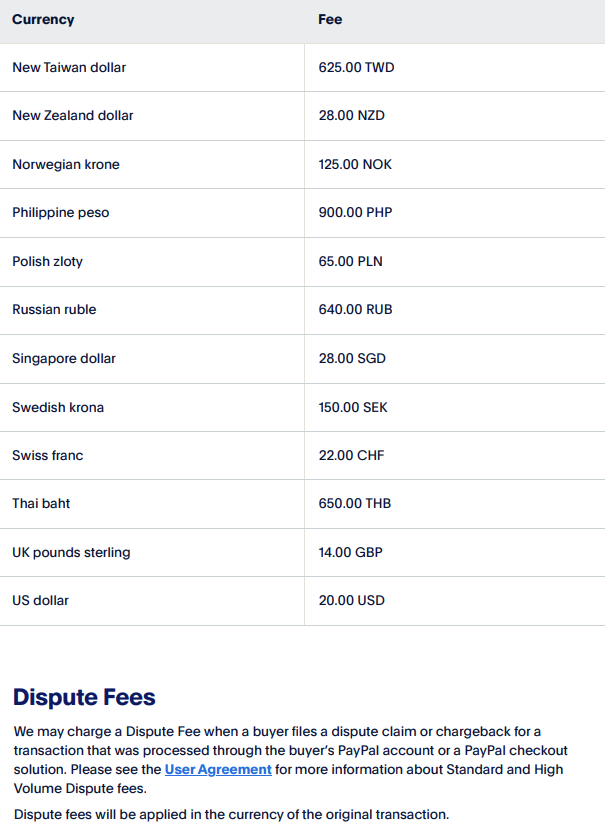
PayPal publishes a separate amount for every currency. The main ones:
| Currency of the original transaction | Chargeback fee |
|---|---|
| US dollar (USD) | 20.00 USD |
| Pound sterling (GBP) | 14.00 GBP |
| Euro (EUR) | 16.00 EUR |
| Canadian dollar (CAD) | 20.00 CAD |
| Australian dollar (AUD) | 22.00 AUD |
| Swiss franc (CHF) | 22.00 CHF |
| Singapore dollar (SGD) | 28.00 SGD |
| New Zealand dollar (NZD) | 28.00 NZD |
| Japanese yen (JPY) | 1,875 JPY |
| Mexican peso (MXN) | 250 MXN |
The dispute fee: $15 or $30
For payments processed through a buyer’s PayPal account or through Guest Checkout, the Dispute Fee rules cover a claim inside PayPal, a chargeback with the card issuer, or a bank reversal. Whether a fee is charged depends on the applicable exemptions.
Three timing details from the User Agreement are easy to miss:
- The amount is set when the dispute case is created, not when it is decided.
- It is deducted after the claim is decided.
- The rate is based on your claim ratio over the previous three calendar months — so a dispute opened in September is priced on June, July and August.
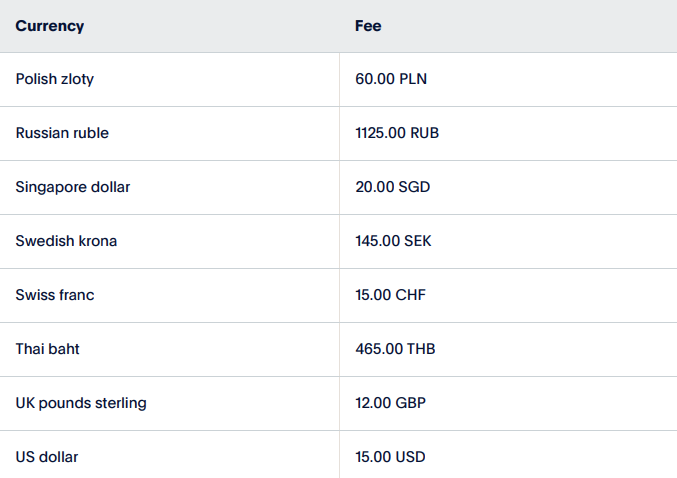
| Fee | US amount | UK | Canada | Euro area |
|---|---|---|---|---|
| Standard Dispute fee | $15.00 | £12.00 | CAD 20.00 | €14.00 |
| High Volume Dispute fee | $30.00 | £24.00 | CAD 40.00 | €28.00 |
| Chargeback fee | $20.00 | £14.00 | CAD 20.00 | €16.00 |
When the dispute fee does not apply
The US User Agreement lists six situations where the Standard Dispute fee is not charged:
- An inquiry in the Resolution Center that is not escalated to a claim.
- A dispute resolved directly between you and the buyer and not escalated.
- A claim filed as an Unauthorized Transaction.
- A dispute PayPal decides met all Seller Protection requirements.
- A claim whose transaction value is less than twice the Standard Dispute fee — under $30 in the US, £24 in the UK, €28 in the euro area.
- A claim decided in your favour by PayPal or your issuer.
The High Volume Dispute fee has a shorter exemption list: Resolution Center inquiries that are not escalated, disputes resolved directly and not escalated, and Unauthorized Transaction claims.
Note that “decided in your favour” appears on the standard list but not on the high-volume list. On the evidence of the published text, a high-volume seller can be charged even when the claim is decided for them.
How the dispute ratio is calculated
Two conditions must both hold for the $30 rate instead of $15:
- Your dispute ratio is 1.50% or more, and
- You had more than 100 sales transactions in the previous three full calendar months.
The ratio counts Item Not Received and Significantly Not as Described claims — filed with PayPal, escalated to PayPal, or raised with the buyer’s card issuer or bank. It excludes Unauthorized Transaction claims.
| Scenario | Ratio | Sales | Fee per dispute |
|---|---|---|---|
| 500 sales, 8 claims | 1.60% | More than 100 | $30 — both conditions met |
| 500 sales, 5 claims | 1.00% | More than 100 | $15 — ratio below 1.50% |
| 80 sales, 5 claims | 6.30% | Not more than 100 | $15 — sales threshold not met |
There is one override worth knowing: where PayPal determines you have engaged in a Restricted Activity, it may charge High Volume Dispute fees for all current and future disputes regardless of your dispute ratio or sales volumes.
Worked example: the same $100 sale, two different fees
Consider an unsuccessful defence of a card chargeback on a $100 domestic US sale. The table assumes that the seller owes the standard Dispute Fee for the PayPal Checkout route and that no waiver applies on the direct card route.
| Paid through PayPal Checkout | Paid by direct card processing | |
|---|---|---|
| Original payment | $100.00 | $100.00 |
| Processing fee | −$3.98 (3.49% + $0.49) | −$3.48 (2.99% + $0.49) |
| You received | $96.02 | $96.52 |
| Amount reversed | −$100.00 | −$100.00 |
| Dispute fee | −$15.00 | — |
| Chargeback fee | — | −$20.00 |
| Net result | −$18.98 | −$23.48 |
Both outcomes are bad, and the direct-card route is worse by $4.50. The important correction is mechanical: the $20 figure does not apply to a PayPal Checkout sale, and any calculator or article that assumes it does will overstate the cost of the common case.
If the same $100 sale had resulted in a claim inside PayPal rather than a card chargeback, the dispute fee applies in the same way — the fee follows the payment route, not the dispute channel.
When the chargeback fee is waived
PayPal states that the chargeback fee is waived if all the requirements of the Seller Protection programme are met. That is the published route to avoiding it, and it is decided on the requirements rather than on whether you happened to win.
Seller Protection eligibility is a separate question with its own evidence rules. See PayPal Seller Protection, and Buyer Protection for what the buyer is claiming under.
Four things sellers get wrong
1. “A chargeback always costs $20”
Only for direct card processing. A chargeback on a PayPal Checkout, Venmo or Guest Checkout payment is priced as a dispute fee — $15 standard, $30 high volume.
2. “I only pay if I lose”
Not what the agreement says. The chargeback fee applies regardless of whether the buyer succeeds, and the dispute fee has its own exemption list in which “decided in your favour” appears for the standard fee but not the high-volume fee.
3. “A high dispute ratio means $30 per dispute”
Only if you also had more than 100 sales transactions in the previous three full calendar months. A 6% ratio on 80 sales still attracts the $15 fee.
4. “Every claim costs me a fee”
The exemption list is longer than most sellers realise: unescalated inquiries, directly resolved disputes, Unauthorized Transaction claims, Seller Protection cases, claims under twice the fee amount, and claims decided in your favour all avoid the Standard Dispute fee.
How to respond to a chargeback
- Check which process you are in and how the payment was taken. The route determines the fee, and it also determines what evidence you can submit.
- Submit evidence within the deadline PayPal specifies, usually through the Resolution Center or the case interface. Late evidence is generally not considered.
- Include tracking and proof of delivery where the claim is non-delivery, and a clear description with documentation where it is “significantly not as described”.
- Try to resolve it before it escalates. An inquiry or a directly resolved dispute avoids the Standard Dispute fee entirely.
- Accept that the outcome is the issuer’s call for card chargebacks. PayPal facilitates the process; it does not decide it.
For the account-side view, see how a PayPal dispute works. If money has been taken that you did not authorise, that is a different route — see reporting an unauthorized transaction.
How to reduce disputes and chargebacks
- Resolve before escalation. A refund or replacement agreed directly with the buyer avoids the dispute fee, because the case never becomes a claim.
- Use a clear statement descriptor. Many card chargebacks are the buyer not recognising the charge.
- Ship with tracking uploaded to PayPal. It is the core requirement for Seller Protection, the only published waiver of the chargeback fee.
- Answer messages quickly. Slow responses push buyers toward their card issuer instead of the Resolution Center.
- Watch the ratio, not just the count. The 1.50% threshold is measured against sales volume, so growth in sales lowers the ratio even if claim numbers stay flat.
- Keep refunds prompt. PayPal lists long refund times as a driver of complaints.
Frequently asked questions
Is the PayPal chargeback fee $20 or $15?
It depends on how the payment was processed. Direct card transactions attract the $20 chargeback fee. Payments processed through a buyer’s PayPal account or PayPal Guest Checkout attract a dispute fee instead — $15 standard, or $30 if your dispute ratio is 1.50% or more and you had more than 100 sales in the previous three full calendar months.
Does a card chargeback on a PayPal Checkout sale cost $20?
No. The chargeback fee is defined for transactions that are not processed through a buyer’s PayPal account or Guest Checkout. A Checkout payment that becomes a card chargeback is priced as a dispute fee.
Is the chargeback fee refunded if I win?
Not automatically. The chargeback fee applies regardless of whether the buyer succeeds with their card issuer. The exception is Seller Protection: where all its requirements are met, PayPal waives the fee.
When is the dispute fee charged?
The amount is determined when the dispute case is created, using your claim ratio from the previous three calendar months, and the fee is deducted after the claim is decided.
Do I pay both fees on one transaction?
The two are defined for mutually exclusive payment routes, so a single transaction should attract one or the other, not both. If you see both on one case, query it with PayPal — the route that processed the original payment determines which fee applies.
Is there a fee if I issue a refund instead?
PayPal does not charge a separate refund fee, but the original processing fee is not returned. A refund therefore costs the processing fee, while a chargeback adds the chargeback or dispute fee on top of the reversal — see how to issue a PayPal refund.
Can the fee make my balance negative?
Yes. The reversed amount and the fee are debited from your account, and if the available balance is not enough the account can go negative. See PayPal negative balance.
Sources and review
Checked on November 25, 2026 against three official PayPal sources:
- PayPal US merchant fee schedule — the chargeback, standard dispute and high-volume dispute tables, including the currency amounts.
- PayPal US User Agreement — the Chargeback fees and Dispute fees sections, including the payment-route condition, the 1.50% and 100-transaction thresholds, the exemption lists, the timing of the fee and the Restricted Activity override.
- What is the chargeback fee? — the Seller Protection waiver and the debit mechanics.
Fees change. Your account’s published schedule and the terms shown at the time of the transaction take precedence over this page. PayFeeCalc is an independent guide and calculator website, not affiliated with, endorsed by or sponsored by PayPal. This is not financial, tax, accounting or legal advice.