
Published: November 6, 2026. Last updated: November 22, 2026.
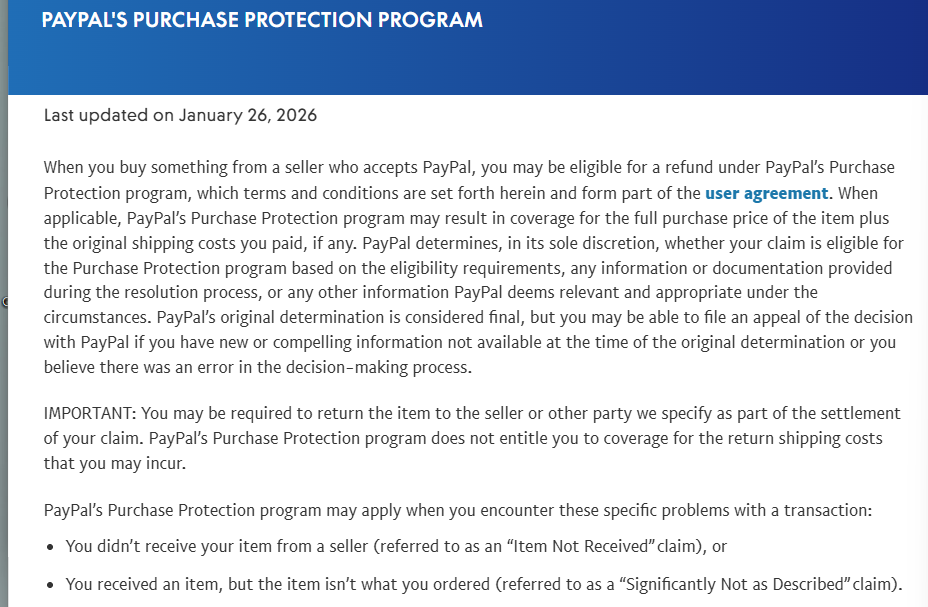
PayPal Buyer Protection, called PayPal Purchase Protection in the United States, may help you recover your money when an eligible purchase never arrives or is significantly different from what the seller advertised. If PayPal decides a qualifying claim in your favor, you may receive a refund of the purchase price and original shipping costs.
However, not every PayPal payment is protected. Coverage depends on the transaction type, purchase eligibility, supporting evidence, and dispute deadlines. For US accounts, you generally have up to 180 days to report an item that never arrived, while purchases that are significantly not as described have an additional, shorter deadline tied to delivery.
This guide explains what PayPal purchase protection covers, which purchases are excluded, how Goods & Services protection works, and how to open and escalate a dispute when something goes wrong.
What Does PayPal Buyer Protection Cover?
PayPal’s US Purchase Protection program primarily addresses two problems: Item Not Received (INR) and Significantly Not as Described (SNAD). Both require an eligible transaction and compliance with PayPal’s dispute process.
1. Item Not Received (INR)
An Item Not Received dispute applies when you pay for an eligible item but it does not arrive. For example, you purchase a laptop from an online seller, the promised delivery date passes, and the seller does not deliver the order or resolve the problem.
However, PayPal’s US policy states that an INR claim will not qualify for reimbursement if the seller provides proof of shipment or delivery. The documentation submitted by both parties can therefore be important to the outcome.
If tracking shows delivery but you cannot locate the package, check the delivery details and contact the seller or shipping carrier promptly. Do not assume that a missing package automatically guarantees a successful PayPal claim.
2. Significantly Not as Described (SNAD)
A Significantly Not as Described claim concerns an eligible item or service that differs materially from the seller’s description. PayPal’s policy identifies several examples of potentially qualifying problems:
- Wrong product: You ordered one item but received something completely different.
- Counterfeit product: The item was advertised as authentic but turns out to be counterfeit.
- Misrepresented condition: An item described as new arrives used, or a significant defect was not disclosed.
- Missing components: Important parts, features, or quantities are missing without prior disclosure.
- Shipping damage: The item arrives damaged in a way that may qualify under PayPal’s policy.
- Unusable item: The product cannot be used in its received condition, and the seller did not disclose that condition.
Not every disappointment qualifies. If a used product arrives with minor scratches that were consistent with its description, or you simply change your mind about an accurately described purchase, PayPal may not consider it significantly not as described.
These distinctions are explained in the official US PayPal Purchase Protection terms.
Does PayPal Goods and Services Protect Buyers?
Yes, eligible Goods & Services payments may qualify for PayPal Buyer Protection. This applies to qualifying purchases made through PayPal, including payments to merchants and eligible purchases from individual sellers.
When sending money to buy a product or service, select the commercial payment option, such as Paying for an item or service, when PayPal offers the choice.
PayPal distinguishes commercial payments from personal transfers:
| Payment type | Intended purpose | Purchase Protection |
|---|---|---|
| Goods & Services | Buying products or services | May apply to eligible transactions |
| Friends & Family | Personal transfers, gifts, and shared expenses | Not covered |
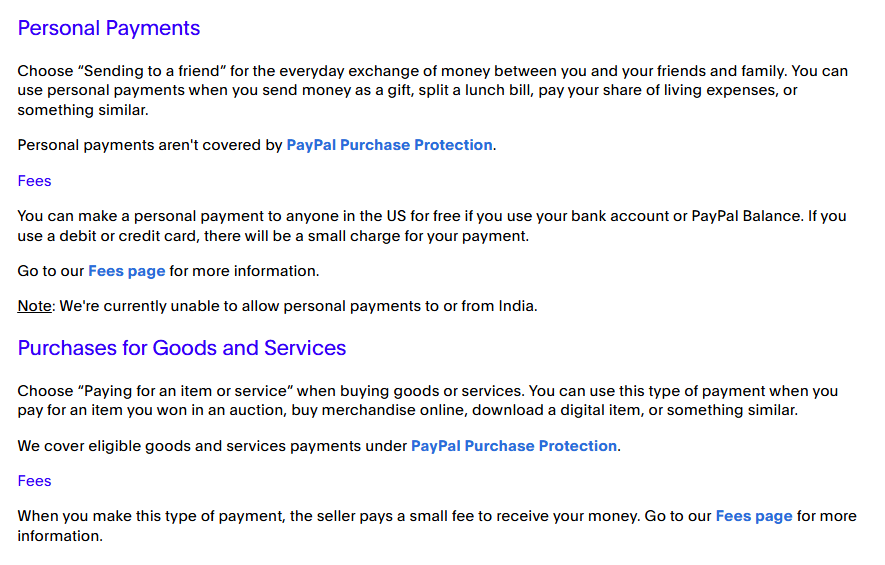
For example, if you buy a used camera from someone you do not know, paying through Goods & Services may make the transaction eligible for protection if the camera never arrives or differs significantly from its description. Paying through Friends & Family would exclude the payment from Purchase Protection.
PayPal does not charge US buyers a separate Purchase Protection fee simply for choosing Goods & Services on an eligible purchase. The seller generally pays the applicable commercial payment-processing fee. Other costs, such as currency conversion, may apply depending on the transaction.
Choosing Goods & Services does not guarantee a refund. The purchase must still satisfy the program’s eligibility requirements and exclusions. For details, see PayPal’s explanation of personal and commercial payments.
Which Purchases Are Eligible for PayPal Purchase Protection?
PayPal Purchase Protection can apply to eligible physical goods, including clothing, household electronics, and other consumer products. Certain intangible purchases, including event tickets and hotel reservations, may also qualify.
Eligibility is determined by the transaction and the applicable PayPal policy, not simply by whether a product is physical or digital.
Under the US program, you must satisfy the following requirements:
- Maintain an eligible account: Your PayPal account must be in good standing.
- Pay through your PayPal account: The purchase must be an eligible payment made from your PayPal account.
- Contact the seller: Attempt to resolve the problem directly with the seller before pursuing a claim.
- Meet the filing deadline: Open the dispute within the applicable timeframe and follow PayPal’s dispute-resolution process.
- Cooperate with the investigation: Submit requested evidence and respond within the time PayPal specifies.
- Avoid duplicate recovery: You must not have already received a recovery or agreed to an alternative resolution from another source for the same purchase.
PayPal evaluates whether the specific transaction qualifies and whether the available information supports the claim. Meeting the basic requirements does not guarantee a favorable decision.
What Is Not Covered by PayPal Buyer Protection?
PayPal’s US Purchase Protection terms exclude certain products, transactions, and payment types. Important exclusions include:
- Personal transfers: Friends & Family payments and other personal payments.
- Real estate: Residential property and other real estate transactions.
- Most vehicles: Motor vehicles, motorcycles, boats, aircraft, and recreational vehicles. Certain personally portable light recreational vehicles, such as bicycles, are exceptions to this exclusion.
- Financial assets: Investments, financial products, gold, and non-fungible tokens (NFTs).
- Cash equivalents: Gift cards, prepaid cards, and other stored-value products.
- Other excluded transactions: Donations, certain gambling activities, government payments, bill payments, purchases of businesses, and industrial manufacturing machinery.
- Resale inventory: Items purchased with the intention of resale, including individual purchases intended for resale.
- Prohibited transactions: Purchases that violate PayPal’s Acceptable Use Policy.
Some exclusions apply only to specific claim types, rather than excluding a purchase from every kind of protection.
Custom-Made Items
Under the US terms, wholly or partly custom-made items are excluded from Significantly Not as Described claims. That does not automatically mean every custom-made purchase is ineligible for an Item Not Received claim. The other eligibility requirements still apply.
In-Person Purchases and Local Pickup
When you pay through a non-QR PayPal transaction and collect an item in person, an Item Not Received claim is generally excluded. However, a Significantly Not as Described claim may still qualify if the item materially differs from the description.
Some PayPal Goods & Services QR-code purchases can qualify for protection, including eligible in-person transactions. The US policy specifically excludes payments made in person using PayPal World via QR code.
Before paying for a high-value item or arranging a local pickup, check the complete US Purchase Protection exclusions rather than assuming every PayPal payment receives the same protection.
PayPal Buyer Protection Deadlines: How Long Do You Have?
Missing a dispute deadline can prevent you from recovering money through PayPal Purchase Protection, even if your purchase would otherwise have qualified.
The US rules distinguish between an item that never arrives and an item that arrives significantly different from its description.
| Action or claim type | US deadline |
|---|---|
| Item Not Received | Open a dispute within 180 days of sending payment. |
| Significantly Not as Described | Open a dispute within 30 days of delivery or fulfillment, or within 180 days of payment, whichever occurs first. |
| Escalating an unresolved dispute | Escalate within 20 days after opening the dispute. |
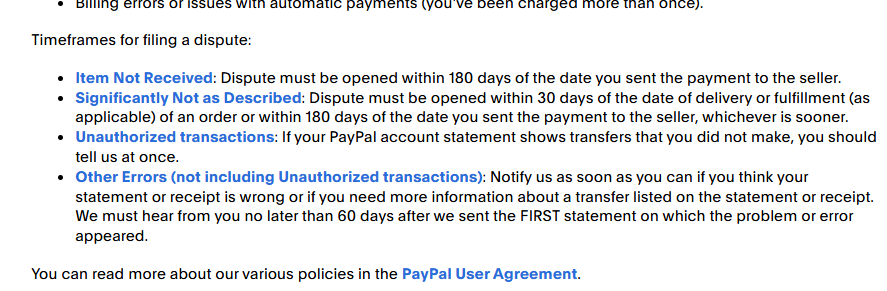
The 180-day deadline does not apply on its own to every type of purchase problem. For Significantly Not as Described claims, the 30-day period after delivery or fulfillment can end earlier.
For example, if an item arrives substantially different from the listing, you should not assume you can wait several months to open the dispute simply because the payment was made less than 180 days ago.
After opening a dispute, you have a separate escalation deadline. If the dispute is not escalated within 20 days, PayPal automatically closes it. A closed dispute cannot ordinarily be reopened or escalated.
PayPal may also require at least seven days to have passed since the original payment before escalation is permitted.
These deadlines are specified in PayPal’s official dispute filing timeframes and its US Purchase Protection terms.
How to Open a PayPal Buyer Protection Dispute
If an eligible purchase never arrives or is significantly different from what you ordered, start by contacting the seller. If the issue remains unresolved, open a dispute through PayPal’s Resolution Center within the applicable deadline.
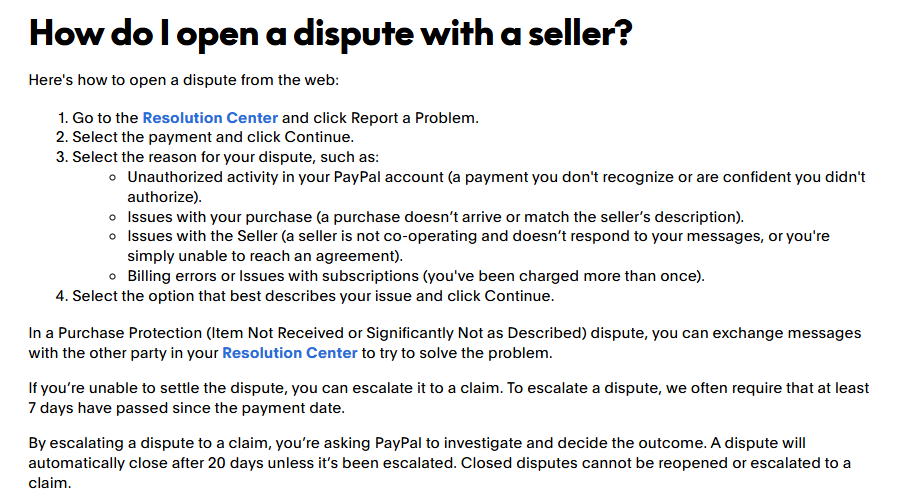
- Sign in to your PayPal account and open the Resolution Center.
- Click Report a Problem.
- Select the payment associated with the purchase and click Continue.
- Choose Issues with your purchase or the relevant purchase-related reason.
- Select the option describing your problem, such as an item that did not arrive or an item that was not as described.
- Provide the requested information, review your details, and follow the prompts to submit the dispute.
Once the dispute is open, you can communicate with the seller through the Resolution Center and attempt to reach an agreement.
At this stage, the dispute allows the two parties to address the problem. It does not automatically mean PayPal has decided that you qualify for a refund.
These steps follow PayPal’s official dispute-opening instructions.
How to Escalate a PayPal Dispute to a Claim
If you and the seller cannot resolve the issue, you can ask PayPal to investigate by escalating the dispute to a claim. This is the stage in which PayPal reviews the available evidence and determines the outcome.
To escalate an eligible dispute through the PayPal website:
- Go to the Resolution Center.
- Select the dispute you want PayPal to review.
- Click Need Help?.
- Select Review my case.
- Add the relevant information and follow the prompts to complete escalation.
Remember that the dispute must be escalated before the 20-day window closes. PayPal may require you to wait at least seven days after the payment before you can escalate.
See PayPal’s claim escalation instructions for the official procedure.
What Evidence Do You Need for a PayPal Claim?
PayPal reviews the transaction details and may request additional documentation from you or the seller. The evidence needed depends on the type of dispute.
Useful supporting records can include:
- Transaction information: The PayPal payment record and purchase date.
- Original listing: Screenshots or copies of the advertised product description, specifications, or condition.
- Order confirmation: Receipts, invoices, or confirmation emails showing what you purchased.
- Seller communication: Messages discussing delivery, defects, incorrect products, or refund requests.
- Shipping evidence: Tracking records, delivery information, or relevant carrier correspondence.
- Photographic evidence: Clear photographs showing damage, missing components, or material differences from the listing.
- Return documentation: Shipping receipts and tracking details if PayPal instructs you to return the item.
In some cases, PayPal may request third-party evaluations, authenticity information, police reports, or other specific documents. These are not automatically required for every claim.
To submit documents, open your case in the Resolution Center, select Respond, choose the option to submit the requested information, and upload the relevant files. Follow the deadlines provided in your case notifications.
PayPal explains this process in its document upload instructions.
How Much Will PayPal Buyer Protection Refund?
If PayPal approves an eligible Purchase Protection claim, reimbursement may include the full purchase price and the original shipping costs paid for the item.
For example, if you paid $120 for a qualifying product and $10 for its original shipping, an approved claim may result in reimbursement of the $130 purchase total.
However, the program does not entitle you to reimbursement for return-shipping costs. In a Significantly Not as Described case, PayPal may require you to return the item at your own expense and provide proof that it was delivered to the specified destination.
Follow PayPal’s instructions before returning an item as part of an open claim. Keep shipping receipts and tracking records, and respond to any further requests for documentation.
A refund is not guaranteed simply because you opened a dispute. PayPal determines eligibility using its Purchase Protection policy and the information available in the case.
How Long Does PayPal Take to Resolve a Claim?
PayPal says it usually decides claims within approximately 14 days, but some cases can take 30 days or longer. The actual timing depends on the evidence required and how quickly the parties respond.
To check your case:
- Sign in to PayPal and open the Resolution Center.
- Find your open case.
- Select View to review the latest status and available details.
- Respond promptly to requests for additional information.
If PayPal is reviewing your claim, the case may display an estimated resolution date. That date is an estimate rather than a guaranteed deadline.
You can also view closed cases through the Resolution Center. See PayPal’s dispute and claim status instructions.
What If PayPal Denies Your Buyer Protection Claim?
If PayPal decides against you, review the decision and identify whether important evidence was missing or whether the program’s eligibility rules affected the outcome.
Under the US terms, an appeal may be possible if you have new or compelling information that was not available when PayPal made its decision, or if you believe there was an error in the decision-making process.
PayPal advises buyers who want to discuss an appeal to contact customer support. Merely disagreeing with a decision, without providing new information or identifying an error, does not guarantee reconsideration.
For details, see PayPal’s claim appeal guidance.
PayPal Buyer Protection vs. Credit Card Chargebacks
If you paid through PayPal using a debit or credit card, your card issuer may offer separate dispute or chargeback rights. Those rights can differ from PayPal’s Purchase Protection rules.
PayPal’s US policy does not allow you to pursue a PayPal Purchase Protection dispute and a card issuer dispute simultaneously for the same transaction, or to obtain a double recovery.
If you open a card issuer dispute while pursuing the same transaction through PayPal, PayPal will close its dispute or claim. If you pursue the card issuer route first, PayPal’s policy also restricts subsequently bringing the same dispute back through its Purchase Protection process.
If PayPal denies your claim, you may still be able to pursue a dispute with your card issuer afterward, subject to the issuer’s own requirements and deadlines. Consider those deadlines before deciding which process to use.
Frequently Asked Questions About PayPal Buyer Protection
Does PayPal Buyer Protection Cover Digital Goods?
Some digital or intangible purchases may qualify. PayPal identifies certain intangible items, including event tickets and hotel reservations, as potentially eligible. Coverage depends on the transaction, the reason for the claim, and applicable exclusions. Digital products should not automatically be treated as either fully protected or entirely excluded.
Does PayPal Protect Purchases Made on Facebook Marketplace?
A purchase arranged through Facebook Marketplace may qualify for PayPal Purchase Protection if you make an eligible Goods & Services payment through your PayPal account and satisfy the other requirements. The marketplace where you found the seller does not itself determine eligibility.
However, paying through Friends & Family is excluded, and local pickups can affect whether an Item Not Received claim qualifies. PayPal Purchase Protection should not be confused with any separate protection provided by a marketplace.
What If My Item Arrives After I Open an Item Not Received Dispute?
If the item arrives but is significantly different from its description, PayPal allows you to change the dispute reason in eligible circumstances. Open the case in the Resolution Center and select Change your reason for this dispute/claim when available.
PayPal states that changing the reason automatically escalates the dispute to a claim. See its dispute reason instructions for details.
Does PayPal Buyer Protection Cover Unauthorized Payments?
Unauthorized transactions are handled separately from ordinary Purchase Protection claims. If you discover a payment you did not authorize, report it through PayPal’s appropriate unauthorized-activity process promptly rather than treating it as an Item Not Received or Significantly Not as Described purchase dispute.
Is PayPal Buyer Protection the Same in Every Country?
No. PayPal’s protection rules, exclusions, procedures, and terminology may vary by country. For example, the United States uses the name Purchase Protection, while the United Kingdom refers to Buyer Protection and maintains its own program terms.
The deadlines and eligibility requirements explained here are based on PayPal’s US Purchase Protection terms, last updated January 26, 2026. Buyers with accounts registered elsewhere should consult the relevant country-specific policy, such as the UK Buyer Protection terms, before filing a claim.