
PayPal Micropayments Fees: 4.99% + $0.09 and Break-Even

Last reviewed: November 25, 2026. Figures come from PayPal’s official US merchant fee schedule and its Dynamic Micropayments help article. The US micropayment rate is 4.99% + $0.09.
What are PayPal micropayments?
Micropayments are a separate PayPal pricing structure for low-value, high-volume sales. Instead of the standard domestic rate of 3.49% + $0.49, an approved merchant pays a higher percentage but a much smaller fixed fee: 4.99% + $0.09.
The trade is deliberate. On small payments the fixed fee dominates — 49 cents on a $2 sale is 24.5% of the transaction on its own. Swapping 1.5 percentage points of rate for 40 cents of fixed fee is a large win when the payment is small, and a large loss when it is not.
Micropayment pricing is not automatic and is not available to every account. It has to be applied for and approved, and PayPal caps the application review at two business days.
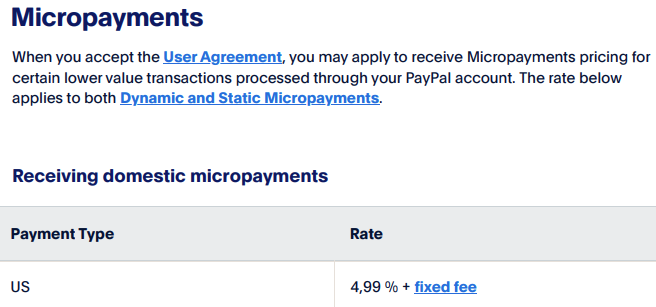
The PayPal micropayment rates
| Item | Rate |
|---|---|
| Domestic micropayments (US) | 4.99% + fixed fee |
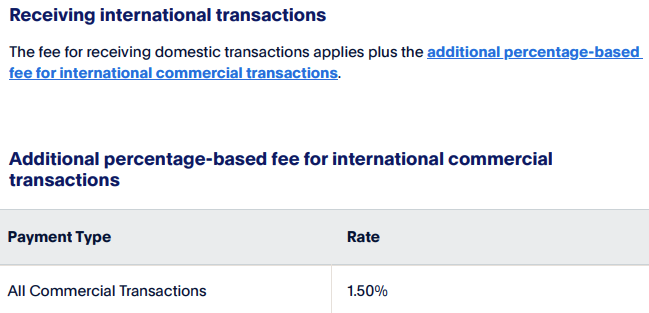
| Additional international micropayment fee | +1.50% |
| Standard domestic rate, for comparison | 3.49% + $0.49 |
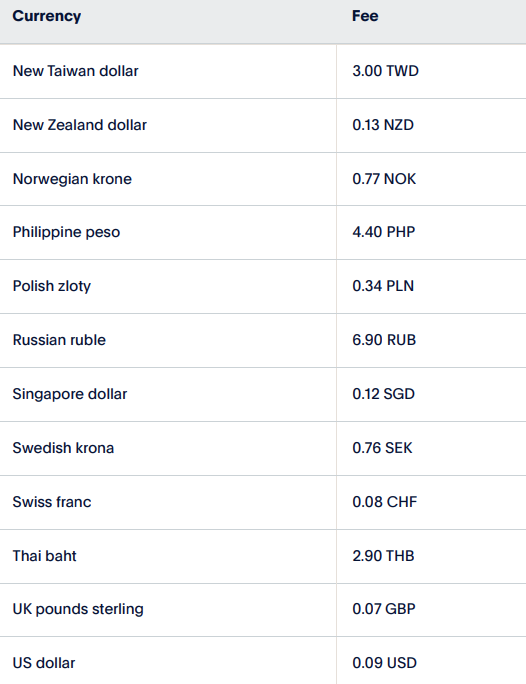
The fixed fee is set per currency received, which is why the same 4.99% produces different totals in different markets. The main ones:
| Currency received | Micropayment fixed fee |
|---|---|
| US dollar (USD) | 0.09 USD |
| Pound sterling (GBP) | 0.07 GBP |
| Euro (EUR) | 0.07 EUR |
| Canadian dollar (CAD) | 0.11 CAD |
| Australian dollar (AUD) | 0.12 AUD |
| Japanese yen (JPY) | 9 JPY |
Compare that with the standard fixed fee of $0.49 in USD: the micropayment structure removes 40 cents of fixed cost and adds 1.5 percentage points of rate.
Micropayments vs standard pricing, amount by amount
Here is the same domestic US payment priced both ways. The cheaper option flips at a single amount.
| Payment | Standard 3.49% + $0.49 | Micropayments 4.99% + $0.09 | Cheaper |
|---|---|---|---|
| $1 | $0.52 | $0.14 | Micropayments |
| $5 | $0.66 | $0.34 | Micropayments |
| $10 | $0.84 | $0.59 | Micropayments |
| $20 | $1.19 | $1.09 | Micropayments |
| $26.67 | $1.42 | $1.42 | Break-even |
| $30 | $1.54 | $1.59 | Standard |
| $50 | $2.24 | $2.59 | Standard |
| $100 | $3.98 | $5.08 | Standard |
On a $5 sale, micropayments save 32 cents — a 48% reduction in the fee. On a $100 sale they cost an extra $1.10. The structure rewards a very specific kind of business.
Where the $26.67 break-even comes from
The break-even is not a policy threshold — it is arithmetic. Set the two total fees equal and solve for the payment amount:
(4.99% × amount) + $0.09 = (3.49% × amount) + $0.49
1.50% × amount = $0.40
amount = $0.40 ÷ 0.015 = $26.67
PayPal’s own guidance lands on the same figure: it states that merchants with frequent transactions of $26.67 or lower for commercial payments generally benefit from micropayment pricing. For donations the break-even is lower — $19.05 — because the standard donation rate is 2.89% rather than 3.49%, so the percentage gap is 2.10 points rather than 1.50.
The $26.67 crossover applies to the domestic US PayPal Checkout comparison above. The standard donation comparison crosses at about $19.05. For a different eligible payment route, compare its normal percentage and fixed fee with the approved micropayment rate. Dynamic pricing makes the comparison one transaction at a time.
Dynamic vs static micropayments
There are two ways the rate can be applied, and the difference matters on mixed order values.
- Dynamic Micropayments (also called Dynamic Pricing). Once approved, PayPal applies either the micropayment rate or the applicable higher-value rate to each transaction — whichever produces the lower fee for that specific payment. The calculation happens at the time of the transaction.
- Static pricing. The micropayment rate applies to eligible transactions regardless of size, so a large order is charged the higher percentage too.
PayPal publishes this worked example of the difference on the same four transactions:
| Transaction | Cost with static micropayments | Cost with Dynamic Micropayments |
|---|---|---|
| $5.37 | $0.36 | $0.36 |
| $20.50 | $1.11 | $1.11 |
| $44.17 | $2.29 | $2.03 |
| $52.30 | $2.70 | $2.32 |
| Total | $6.46 | $5.82 |
On the two small payments the two approaches are identical, because micropayments already win below the break-even. The saving appears on the larger payments, where dynamic pricing silently switches back to the standard rate. If your order values vary, dynamic pricing removes the risk of overpaying on the occasional big sale.
Who is eligible for micropayment pricing
PayPal’s stated eligibility rules for Dynamic Micropayments are narrow:
- You must have a business account opened directly with PayPal.
- Business accounts created through a third-party platform are excluded.
- Personal accounts are excluded.
- Merchants already on custom pricing cannot enrol.
Eligible payment types are PayPal Checkout, Donations, Standard Credit and Debit Card Payments, and Goods and Services Payments. PayPal states plainly that not all payment types are eligible, so the rate does not apply to everything your account processes.
How to enrol — and how to check it worked
- Request enrolment for Dynamic Micropayments on your PayPal Business account.
- PayPal states the request takes up to two business days.
- Once payments start arriving, open the Activity Download report and review the fee information for individual transactions.
- Check a small payment and a larger one. Under dynamic pricing the smaller one should show the micropayment structure and the larger one the standard structure.
Do not rely on the rate shown in a marketing page — confirm it against the fee actually deducted in your own report.
You may not need micropayments at all
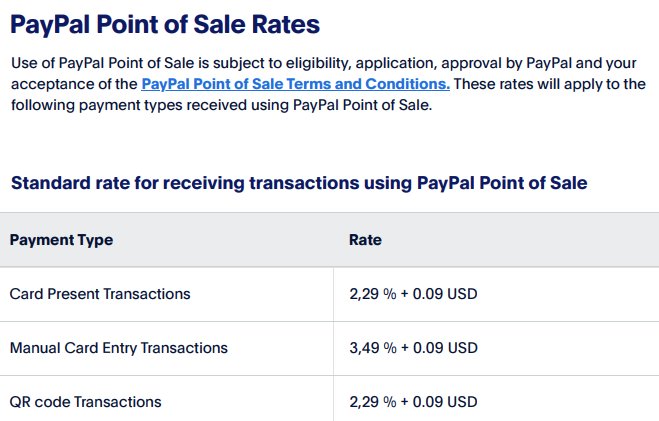
Micropayments are not the cheapest small-payment structure PayPal offers. For payments you can take in person, the QR and card-present rates use the same $0.09 fixed fee but a far lower percentage:
| Rate structure | Percentage | Fixed fee (USD) |
|---|---|---|
| QR code transactions | 2.29% | $0.09 |
| Card present (PayPal Point of Sale) | 2.29% | $0.09 |
| Manual card entry | 3.49% | $0.09 |
| Micropayments | 4.99% | $0.09 |
| Standard online checkout | 3.49% | $0.49 |
Read that table carefully. A QR payment and a micropayment carry the same nine-cent fixed fee, but QR is charged at 2.29% against 4.99% — a 2.7 percentage point difference on an identical fixed cost. If your low-value sales can be taken face to face, QR or card present beats micropayment pricing outright and no enrolment is needed.
If you sell remotely, check which routes your account can use. PayPal lists Checkout, Donations, standard credit and debit card payments, and Goods & Services payments among Dynamic Micropayments’ eligible types. Confirm the eligibility and normal rate of the specific payment route you want to compare.
Worked example: a $5 digital-product store
Take an online store selling $5 downloads to US customers, 1,000 sales a month — $5,000 of revenue. Here is the monthly fee under each structure, using the published US rates:
| Structure | Fee per $5 sale | Monthly fees | Effective rate |
|---|---|---|---|
| Standard 3.49% + $0.49 | $0.66 | $660.00 | 13.20% |
| Micropayments 4.99% + $0.09 | $0.34 | $340.00 | 6.80% |
| Donations rate 2.89% + $0.49 (not applicable to sales) | $0.63 | $630.00 | 12.60% |
| QR / card present 2.29% + $0.09 (in person only) | $0.20 | $200.00 | 4.00% |
Micropayments cut the monthly bill from $660 to $340 — $320 a month, or $3,840 a year — and halve the effective rate from 13.2% to 6.8%. On this order profile the structure is transformative.
Now change one variable. If that same store sold at $50 instead of $5, micropayments would cost $2.59 a sale against $2.24 standard — an extra $350 a month. The same enrolment, the same business, the opposite result. The average order value is the only thing that changed.
The average-order test
Before applying, check how often each eligible payment route is used and at what amounts. The table below uses the domestic US PayPal Checkout rate. It compares static pricing at those order sizes and shows where dynamic pricing can help a mixed basket.
| Order size (US PayPal Checkout comparison) | Static and dynamic micropayment pricing |
|---|---|
| Below $26.67 | Static micropayments generally cost less. Dynamic pricing uses the lower eligible rate. |
| Around $26.67 | The two fees are approximately equal for this route. |
| Mix of payments above and below $26.67 | Dynamic pricing can use the cheaper eligible rate for each transaction. Compare your actual mix before using static pricing. |
| All payments above $26.67 | Static micropayments generally cost more. Dynamic pricing uses the lower eligible standard rate for this route. |
Do not use your cheapest product or your best-selling item as the proxy. Use the average of completed, paid orders — refunds and abandoned carts do not attract a fee.
When micropayments are the wrong choice
With static pricing, orders above the crossover for the same payment route can cost more. These situations are worth checking before enrolling:
- Mixed baskets on the PayPal Checkout rates shown above. At $40, static micropayments cost about $2.09 versus $1.89 at the standard rate. Dynamic pricing uses the lower eligible rate for that payment.
- Static pricing on a wide range. Without dynamic pricing, the higher percentage applies to large orders as well. PayPal’s own example shows $2.70 instead of $2.32 on a $52.30 sale.
The practical test is the average, not the smallest sale. A business with mostly $3 sales and a handful of $200 orders can still win under dynamic pricing, because the large orders fall back to the standard rate automatically.
What micropayments do not change
Micropayment pricing changes the transaction fee only. Everything around the transaction keeps its own rules:
- Disputes and chargebacks. The payment route determines which rules apply. The $15 US Standard Dispute Fee is waived on claims for transactions under $30, including a $5 micropayment. The $30 High Volume Dispute Fee has different exemptions. The $20 USD chargeback fee can apply to qualifying direct card transactions.
- Refunds. The original fee is not returned when you refund, and with a 4.99% rate the retained amount is larger. See how to issue a PayPal refund.
- Currency conversion. Converting a payment into your primary currency still carries PayPal’s conversion spread — see international fees and currency conversion.
- Withdrawals. Moving the money to your bank is priced separately — see the withdrawal fee calculator.
Because of the fixed-fee trade, micropayments also make the effective rate on tiny payments close to the headline rate. On a $2 sale, 4.99% + $0.09 is $0.19, an effective 9.5% — still far better than $0.56 at the standard rate, but not a small number.
Frequently asked questions
What is the PayPal micropayment fee?
4.99% plus a fixed fee of $0.09 in US dollars for domestic payments to a US account. International micropayment transactions carry an additional 1.50%. The fixed fee varies by currency — £0.07, €0.07, CAD 0.11, AUD 0.12.
Is there a minimum transaction size for micropayments?
PayPal does not publish a minimum amount below which the rate is refused. What it does publish is the economics: micropayment pricing generally benefits merchants with frequent transactions of $26.67 or less for commercial payments, or $19.05 for donations.
Do micropayments apply to every payment on my account?
Not necessarily. Only some payment types are eligible, and under Dynamic Micropayments PayPal applies whichever rate is cheaper per transaction — so larger payments can still be charged the standard rate.
Can I switch back if micropayments cost me more?
Contact PayPal to discuss your pricing. Do this before you enrol with a static structure, because a 1.5 percentage-point increase on every larger order is expensive to unwind once it has applied for a period.
Do micropayments reduce the chargeback fee?
Micropayment pricing does not change the dispute rules. In the US, the $15 Standard Dispute Fee does not apply to a claim on a transaction below $30. High-volume disputes and qualifying direct card chargebacks are assessed under their own rules.
How do I know if micropayments were approved?
PayPal states the enrolment request takes up to two business days. After payments start arriving, open the Activity Download report and compare the fees deducted on a small payment with a larger one.
Sources and review
Checked on November 25, 2026 against two official PayPal sources:
- PayPal US merchant fee schedule — the domestic micropayment rate, the additional international fee and the per-currency fixed fee table.
- What are Dynamic Micropayments? — the automatic lowest-rate mechanism, eligible payment types, the $26.67 and $19.05 guidance figures, the eligibility exclusions, the two-business-day enrolment and the worked four-transaction example.
The break-even figures and the comparison tables on this page were calculated from those published rates. Fees change: your account’s schedule and the amounts actually deducted in your reports take precedence over this page. PayFeeCalc is an independent guide and calculator website, not affiliated with, endorsed by or sponsored by PayPal. This is not financial, tax, accounting or legal advice.