
PayPal vs Zelle: Fees, Speed and Purchase Protection

Last reviewed: November 25, 2026. Zelle figures come from Zelle’s own FAQs and its small-business pages. PayPal figures come from its US consumer and merchant fee schedules. Zelle is a US-only service, and transaction limits are set by your own bank rather than by Zelle.
The short answer
For US personal payments, many banks offer Zelle without a fee. PayPal can also be free for eligible domestic personal payments funded from a balance or bank account. For business payments, check the bank’s Zelle policy and the rate for the PayPal product you use.
Zelle transfers money directly between eligible US bank accounts and does not provide purchase protection. PayPal has a Resolution Center and documented protection programs for eligible payments. Whether protection applies depends on the transaction and program rules.
For a business selling to people it does not know, that difference decides the answer more often than the fee does. For a business taking payment from a regular customer at the counter, Zelle is usually the better tool.
Fee comparison
| What you pay for | Zelle | PayPal |
|---|---|---|
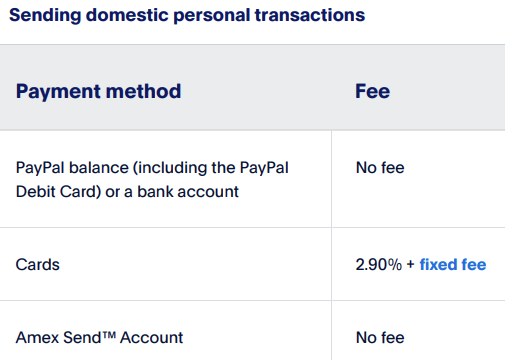
| Sending or receiving money, consumer | Typically no fee — confirm with your bank | Free from balance or bank; 2.90% + $0.30 from a card |
| Accepting a business payment | The bank sets the price for its eligible business accounts | 3.49% + $0.49 for Checkout or 2.99% + $0.49 for standard cards |
| Getting the money to your bank | Direct — it lands in your account, typically within minutes | Standard transfer free; instant 1.75%, min $0.25, max $25 |
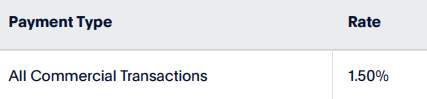
| International receiving | Not supported — US bank accounts only | Supported; +1.50% commercial surcharge plus conversion spread |
| Dispute / chargeback fee | Not applicable — no chargeback route | $15–$30 dispute fee, or $20 for direct card processing |
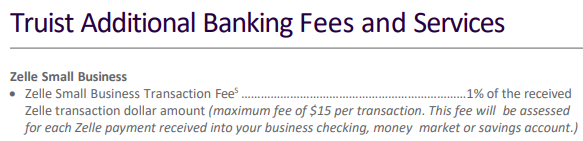
For a $1,000 US sale, PayPal Checkout costs $35.39 at the published standard rate. With Zelle, an eligible business account with no receiving charge would pay $0. Truist, for example, charges 1% on incoming Zelle business payments, capped at $15, so the same $1,000 receipt would cost $10 there. Check your own bank’s terms.
How Zelle fees and payment cancellation work
Zelle is operated by Early Warning Services and moves money between participating US bank accounts. Financial institutions set their own account terms, including any consumer or business fees.
An ordinary transfer to an enrolled Zelle recipient generally can’t be canceled in the app. You may be able to cancel a pending transfer to someone who has not enrolled. Contact your bank promptly about an unauthorized payment or suspected scam.
Compare the bank’s fee policy and whether the type of payment you plan to make has purchase protection. For a fraud report, use your bank’s process.
Protection: the real difference
| Zelle | PayPal | |
|---|---|---|
| Can I cancel or dispute a payment? | Usually cannot cancel once the recipient is enrolled. Ask your bank about fraud or eligible reimbursement. | Some payments can be canceled. Eligible disputes or chargebacks may result in a refund. |
| Purchase protection programme | None | Buyer Protection and Seller Protection |
| Dispute channel | Your bank, after the fact | Resolution Center, with published deadlines |
| Who decides a dispute | No Zelle-level process | PayPal, or the card issuer for a chargeback |
| Typical fraud exposure | The full amount, immediately | Reduced for eligible protected transactions |
A buyer purchasing from an unfamiliar seller can choose a PayPal transaction eligible for Purchase Protection. A seller using Zelle should check its bank’s own rules for fraud reports and qualifying reimbursements.
Zelle’s guidance is to send money to people you know and trust. Its small-business guidance also describes customers paying a business they know and trust.
Does Zelle work for a business?
Yes, within limits. Zelle has a small-business offering, delivered through participating banks rather than as a standalone product. What it provides:
- A Zelle QR code you can display at a counter, put on an invoice or share from your phone, so a customer can scan and pay without typing your details.
- A Zelle tag for the business, so you do not have to give out a personal email address or mobile number.
- Receive, request and send money — including paying suppliers and employees.
- Enrolment through your banking app on a qualifying business account, and only if your bank or credit union offers Zelle to small businesses.
What it does not provide is equally important: no invoicing with payment tracking, no subscription billing, no checkout button for a website, no international payments and no payment-protection programme. For a service business collecting at the counter it is close to ideal. For an online store selling to strangers it is a poor fit.
Scams and the reimbursement nuance
Older articles say Zelle offers no recourse of any kind. That is now partly out of date: Zelle’s own FAQ states that qualifying imposter scams may be eligible for reimbursement, directs users to their bank or credit union, and offers the option to report to the FTC.
The important word is qualifying. Reimbursement is decided by your bank under its own terms, covers imposter scams rather than a change of mind, and does not turn Zelle into a protected payment method. If a buyer pays you and later disputes the goods, there is still no mechanism inside Zelle to reverse it.
When Zelle is the better choice
- A regular customer paying at the counter. Funds go directly to the bank account. Check what your bank charges to receive a business payment.
- Small amounts where a fixed fee matters. On a $25 sale, standard PayPal Checkout costs about $1.36. Compare the receiving fee for your eligible bank account before choosing Zelle.
- Paying a trusted supplier domestically. Confirm both parties’ eligibility, limits and any sending fee with the participating banks.
- An existing relationship where you are confident in the payer. Zelle’s own framing assumes the customer knows and trusts the business.
When PayPal is the better choice
- Selling to a first-time buyer. PayPal Checkout offers a payment flow with protection for eligible purchases. Check the protection terms for that transaction.
- Online sales. A checkout button, invoices and payment tracking — Zelle offers none of these for a website.
- Anything international. Zelle requires both parties to hold US bank accounts.
- Recurring billing or subscriptions. No equivalent in Zelle.
- High-value orders. The percentage fee is the same, but the exposure without protection is much larger.
Can you offer both?
An eligible US business can offer PayPal at checkout and Zelle for regular customers who prefer a bank transfer. Check the PayPal product fees and the bank’s account and transaction charges.
Two practical rules make the combination safer. Display the Zelle QR code or tag rather than a personal phone number, so payments reach the business account with a clear reference. And keep the two flows separate in your records — Zelle payments land in your bank account directly, with no PayPal transaction record to reconcile against.
Frequently asked questions
Does Zelle charge a fee?
Many participating banks offer Zelle without consumer transaction fees. Business account terms vary by bank. Check both the conditions for your account and any fee for receiving business payments.
Can a Zelle payment be reversed?
You can generally cancel a Zelle payment only if the recipient has not enrolled. If you suspect fraud or an impersonation scam, report it to your bank. Some cases qualify for reimbursement, which is separate from canceling the payment.
Is Zelle safe for selling online?
It is a poor fit for selling to strangers. There is no purchase protection, no dispute process inside Zelle and no checkout for a website. Zelle’s own materials frame it around customers who already know and trust the business.
Does Zelle work outside the US?
No. Both the sender and the recipient must have US bank accounts. For international payments PayPal operates in 200+ markets, with a +1.50% commercial surcharge and a currency conversion spread.
Can I get my money back if I am scammed on Zelle?
Zelle states that qualifying imposter scams may be eligible for reimbursement, decided by your bank or credit union, and you can report to the FTC. That is narrower than a purchase-protection scheme: it does not cover a buyer who later changes their mind about goods received.
Which is cheaper for a business, Zelle or PayPal?
Compare the receiving fee your bank quotes for Zelle with the applicable PayPal rate. For example, PayPal Checkout charges 3.49% + $0.49 at the published standard rate. Consider whether the customer needs an online checkout, purchase protection or an international payment option.
Sources and review
Checked on November 25, 2026 against:
- Zelle Help Center — consumer fees, US bank account requirements and when a pending payment can be canceled. See the Zelle fraud and scams guidance for bank reporting and qualifying reimbursements.
- Zelle for Businesses — the QR code, the Zelle tag, the receive/request/send functions, enrolment through a banking app and the “small business they know and trust” framing.
- PayPal US consumer fee schedule — personal sending rates and instant and standard transfer fees.
- PayPal US merchant fee schedule — Checkout and card rates, the international surcharge and the chargeback fee.
Comparison figures were calculated from those published rates and are illustrative, not a quote. Zelle transaction limits are set by the sending bank and are not published network-wide, so this page does not state a figure. PayFeeCalc is an independent guide and calculator website, not affiliated with, endorsed by or sponsored by PayPal or Zelle. This is not financial, tax, accounting or legal advice.