
PayPal vs Payoneer: Fee Comparison and When to Use Each

Last reviewed: November 25, 2026. Corrected after a source check against PayPal’s official invoicing fee table. PayPal figures come from its US merchant and consumer fee schedules; Payoneer figures come from its official pricing page (last updated 1 January 2026). Both providers vary pricing by account, country and corridor.
The short answer
For bank-funded payments — a client paying an invoice by bank transfer or ACH — the two are close, and the winner depends on the amount and on which Payoneer route you use.
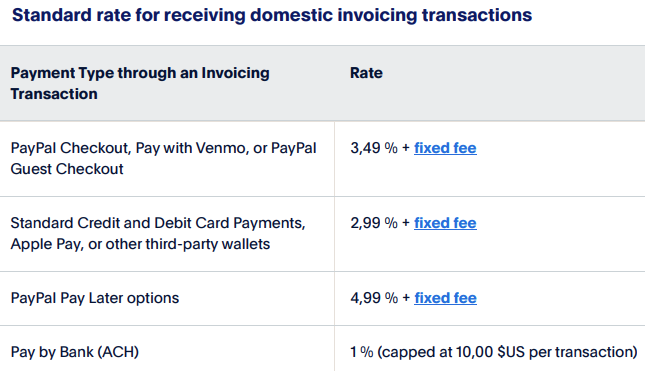
For eligible US invoices, PayPal’s Pay by Bank (ACH) rate is 1%, capped at $10 per transaction. Payoneer lists free local-currency receiving and a $1.50 withdrawal fee when the bank, currency and account meet its conditions. If those fees apply and you make one withdrawal per payment, the two routes tie at $150 before annual or other charges.
For card-funded payments, compare the actual Payoneer card quote with PayPal’s published rate for the matching card route. Marketplace payouts have their own fee schedules.
An earlier version of this page compared PayPal Checkout (3.49% + $0.49) against Payoneer and missed the Pay by Bank route. That comparison overstated PayPal’s cost on bank-funded invoices and is corrected below.
Every receiving route, side by side
| How the money arrives | Provider | Cost to receive | Then to your bank |
|---|---|---|---|
| Client pays a PayPal invoice by bank (ACH) | PayPal | 1%, capped at $10.00 | Standard transfer free |
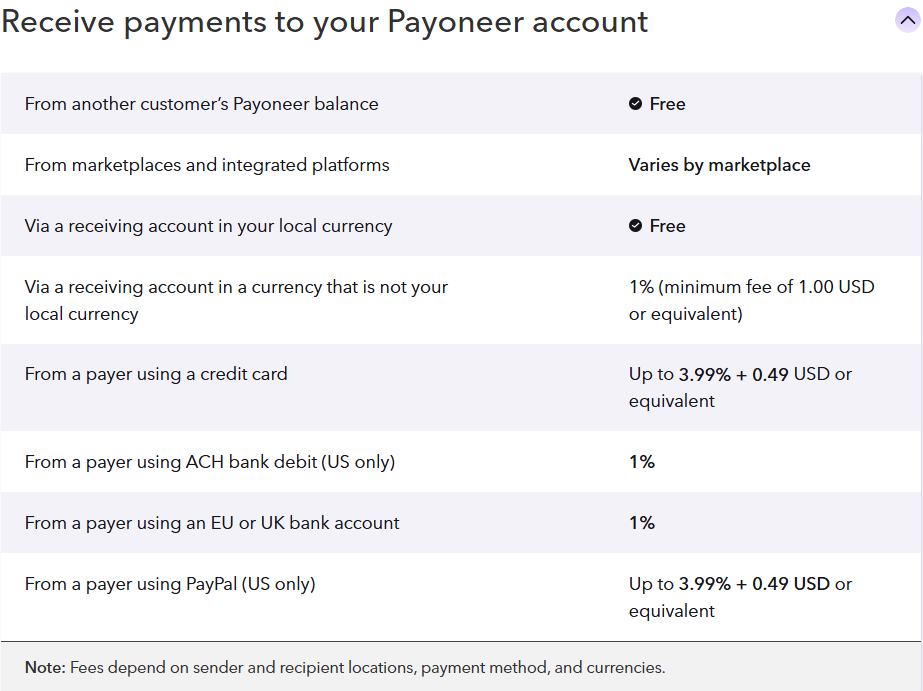
| Client sends to your local-currency receiving account | Payoneer | Free | $1.50 when the account and withdrawal qualify |
| Client sends to a non-local-currency receiving account | Payoneer | 1% (minimum $1.00) | $1.50, or 1.2%–4% cross-border |
| Client pays by ACH, EU or UK bank debit | Payoneer | 1% | $1.50, or 1.2%–4% cross-border |
| Client pays a PayPal invoice by card | PayPal | 2.99% + $0.49 | Standard transfer free |
| Client pays by PayPal Checkout | PayPal | 3.49% + $0.49 | Standard transfer free |
| Client pays by card or from PayPal | Payoneer | Up to 3.99% + $0.49 | $1.50, or 1.2%–4% cross-border |
| Receive from another Payoneer customer’s balance | Payoneer | Free to receive | Check the withdrawal fee for your bank and currency |
PayPal’s $10 ceiling limits the cost of an eligible bank-funded invoice. Payoneer’s free local receiving option can cost less when your withdrawal qualifies for the $1.50 fee. Your account and bank details determine which withdrawal rate applies.
Worked example: $1,000 from a client
One $1,000 payment from a client, then withdrawn to your own bank in the same country and local currency. Published rates, cheapest first:
| Route | Total cost | You keep | Effective |
|---|---|---|---|
| Payoneer — local-currency receiving account (free) + $1.50 withdrawal | $1.50 | $998.50 | 0.15% |
| PayPal — Pay by Bank on an invoice (1%, capped) | $10.00 | $990.00 | 1.00% |
| Payoneer — 1% receiving account + $1.50 withdrawal | $11.50 | $988.50 | 1.15% |
| PayPal — Goods & Services direct | $29.90 | $970.10 | 2.99% |
| PayPal — invoice paid by standard card | $30.39 | $969.61 | 3.04% |
| PayPal — Checkout wallet payment | $35.39 | $964.61 | 3.54% |
| Payoneer — client pays by card or from PayPal | $41.89 | $958.11 | 4.19% |
The spread between the best and worst route is $40.39 on a single invoice — more than 4% of the payment. The route matters far more than the provider.
Where the $150 crossover comes from
For this illustration, compare an eligible US PayPal Pay by Bank invoice with a Payoneer local-currency receipt that costs nothing to receive and $1.50 to withdraw. Assume one withdrawal per payment with no conversion, annual fee or other charge. The crossover for this example is:
1% × amount = $1.50 → amount = $150
| Invoice | PayPal Pay by Bank | Payoneer local account | Cheaper |
|---|---|---|---|
| $100 | $1.00 | $1.50 | PayPal |
| $150 | $1.50 | $1.50 | Level |
| $500 | $5.00 | $1.50 | Payoneer |
| $1,000 | $10.00 | $1.50 | Payoneer |
| $5,000 | $10.00 (cap) | $1.50 | Payoneer |
Because PayPal’s fee is capped, the gap widens with invoice size — but only up to $10. Above roughly $1,000 the PayPal fee stops growing at $10, so the absolute difference stops at about $8.50 per invoice.
The withdrawal corridor is the hidden cost
Payoneer’s $1.50 withdrawal example depends on the matching currency, bank location and account terms. The pricing page also lists a monthly threshold for certain US customers and separate ranges for other withdrawals.
- Eligible local withdrawal: $1.50 when the currency of the receiving balance and the bank account match, the bank is in the relevant country, and the account qualifies for the fixed fee.
- Different currency or country — 1.2% to 4%, with minimum fees of up to $20.00 in some countries.
- Certain US customers — a fixed $1.50 per withdrawal up to $50,000 a month, then up to 0.5%.
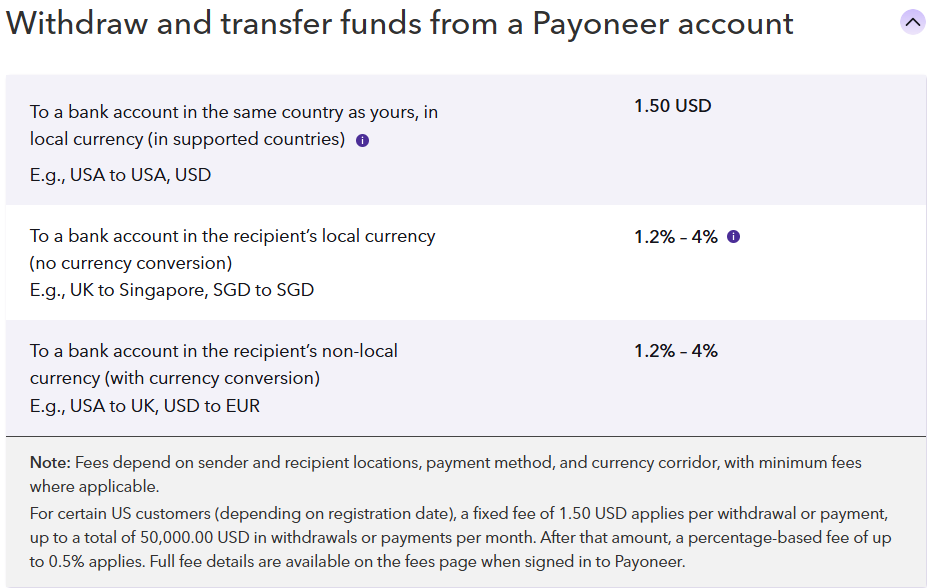
On a $5,000 cross-border withdrawal at 3%, Payoneer’s fee is $150 — which turns a 0.15% all-in cost into roughly 3%. The corridor can wipe out the entire advantage. Check yours before assuming Payoneer wins.
PayPal’s equivalent is a standard transfer to your own bank, free when no currency conversion is involved, or an instant transfer at 1.75% (minimum $0.25, maximum $25). Cross-currency payments carry PayPal’s conversion spread of 3%–4%.
Fees that catch people out
| Fee | PayPal | Payoneer |
|---|---|---|
| Annual account fee | None | $29.95 charged when you receive less than $6,000 in any 12 consecutive months; not charged in the first year on paid annual plans |
| Annual card fee | None for the consumer Debit Card | $29.95 per year, one fee regardless of how many cards |
| ATM withdrawal | $2.50 non-MoneyPass, free at MoneyPass, $400 daily limit | $3.15 plus up to 1.8%, or 3.5% with conversion |
| ATM balance check or decline | No charge | $1.00 |
| Card replacement | No charge | $12.95 |
| Move between your own currency balances | Conversion spread | 0.50% |
The annual fee runs the opposite way to most people’s assumption: low volume is what triggers it. Receiving under $6,000 in a year is the condition that produces the $29.95 charge, not the condition that avoids it. At $3,000 of annual receipts that fee alone is an extra 1.00%; at $5,000 it is 0.60%; at $6,000 it stops.
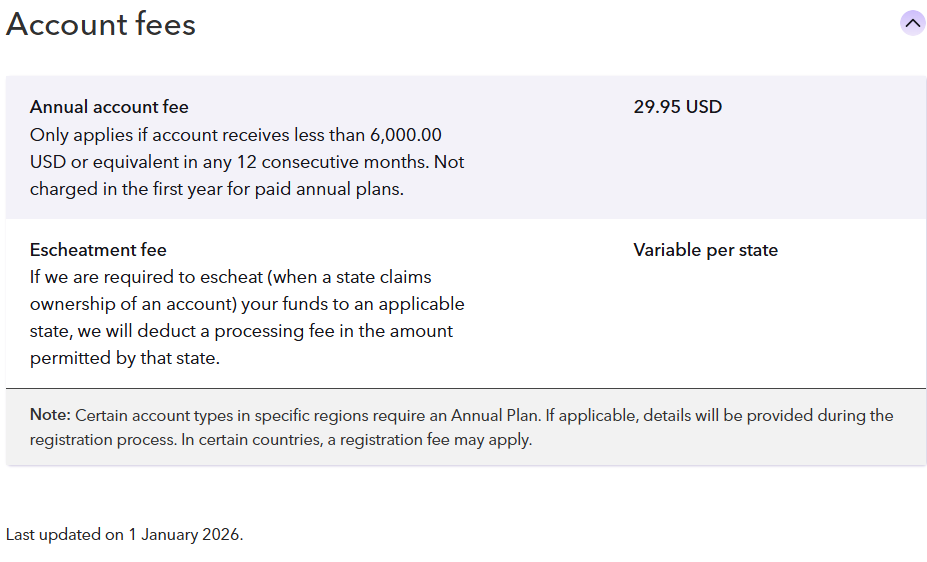
A low-volume freelancer can compare the two routes over the same 12-month period. Add the applicable $29.95 Payoneer account fee to the receiving and withdrawal totals, then compare them with the total PayPal invoice fees.
Where PayPal wins
- Card payments. 2.99% + $0.49 on a standard card route beats Payoneer’s up-to-3.99% + $0.49.
- Bank-funded invoices: PayPal caps its ACH fee at $10 on eligible US invoices. It can cost less than Payoneer’s 1% receiving route plus withdrawal, even when a qualifying free Payoneer receipt is cheaper.
- No annual fee, no card fee. At low volume, the absence of fixed charges can beat a lower percentage.
- Buyer familiarity and protection. Buyer Protection and Seller Protection are established, documented programmes.
- Selling to consumers. PayPal is a checkout; Payoneer is a business receiving account.
Where Payoneer wins
- Local-currency receiving accounts. Free to receive, which is a rate PayPal does not offer on any route.
- Marketplace payouts. Upwork, Fiverr, Amazon and similar platforms pay out through Payoneer by design; the fee varies by marketplace.
- Multi-currency operations. Moving between your own balances costs 0.50%, cheaper than PayPal’s conversion spread.
- Long-term B2B relationships where the client pays by local bank transfer every month and you withdraw in the same currency.
- Paying suppliers and contractors in local currencies from a single balance.
Should you use both?
Usually yes. Neither charges a monthly fee on its basic account, so the only cost of running both is managing two balances. The split that follows from the fee tables:
- Payoneer for marketplace payouts and for clients paying into a local-currency receiving account, provided you can withdraw to a same-country bank in that currency.
- PayPal for consumer sales, card payments, and bank-funded invoices where Pay by Bank is available.
Be explicit about the annual fee when deciding. Payoneer is free to hold, but it is not free to use at low volume — the $29.95 charge applies precisely when receipts fall below $6,000 in a 12-month window.
Frequently asked questions
Which is cheaper, PayPal or Payoneer?
In the bank-payment example above, Payoneer’s eligible free local receipt plus a $1.50 withdrawal costs less above $150. PayPal’s Pay by Bank costs less below that amount. Card payments need a separate comparison: PayPal charges 2.99% + $0.49 on standard invoice card payments, and Payoneer publishes up to 3.99% + $0.49 for card payments.
Does PayPal have a 1% bank payment option?
Yes. PayPal’s US invoicing schedule lists Pay by Bank (ACH) at 1%, capped at $10.00 per transaction. It sits alongside Checkout and Guest Checkout at 3.49% + $0.49 and standard card payments at 2.99% + $0.49, and is a separate route rather than the default.
Does Payoneer charge an annual fee?
Yes, in some circumstances: $29.95 applies when the account receives less than $6,000 in any 12 consecutive months, and it is not charged in the first year on paid annual plans. A separate $29.95 annual card fee also exists.
Can I receive PayPal payments into Payoneer?
Payoneer lists “from a payer using PayPal (US only)” at up to 3.99% + 0.49 USD. That is more expensive than receiving the same payment directly into PayPal, so it only makes sense if you want the funds consolidated in one account.
Which is better for Upwork or Fiverr?
The available payout options depend on the marketplace and your country. Use its published payout fee and any receiving, conversion or withdrawal fees that apply to your account. A platform payout can have different pricing from an ordinary client invoice.
Does PayPal charge for withdrawing to my bank?
A standard transfer is free when no currency conversion is involved. An instant transfer costs 1.75% with a $0.25 minimum and a $25 maximum in the US. See the withdrawal fee calculator.
What about currency conversion on each platform?
PayPal applies a conversion spread of 4% on specified payment conversions and 3% on others, disclosed in its fee schedule. Payoneer charges 0.50% to move between your own balances, but applies 1.2%–4% on cross-border withdrawals where conversion is involved. Both are worth calculating before you choose a payout currency — see international fees and currency conversion.
Sources and review
Checked on November 25, 2026 against:
- PayPal US merchant fee schedule — the domestic invoicing table including Pay by Bank (ACH) at 1% capped at $10.00, Checkout and card rates, the international invoicing surcharge and the chargeback tiers.
- PayPal US consumer fee schedule — instant and standard transfer fees and the conversion spread.
- Payoneer Pricing (last updated 1 January 2026) — receiving rates by funding method including the free local-currency receiving account, withdrawal bands, the balance-conversion fee, card fees and the annual account fee threshold.
All comparison figures on this page were calculated from those published rates. Both providers state that headline pricing is indicative: your account’s own fee page, shown when signed in, takes precedence. PayFeeCalc is an independent guide and calculator website, not affiliated with, endorsed by or sponsored by PayPal or Payoneer. This is not financial, tax, accounting or legal advice.