
To compare PayPal fees by country, start with the account market whose charge you are calculating, then match the payment product, currency, and the other party’s location. For a seller’s receiving fee, use the seller’s local merchant schedule—not the buyer’s country or a fee attached to the currency alone.
This guide covers selected commercial receiving rates in 11 markets, followed by personal-transfer and withdrawal examples. The tables identify the payment category rather than presenting one universal rate per country. They exclude negotiated pricing, specialist products, and additional costs unless stated. Country names link to the applicable official sources.
Table of Contents
PayPal fees by country: commercial receiving rates
The fees below are charged to the recipient for the named commercial payment. A percentage is applied to the payment amount, and the fixed charge uses the currency shown. In the international column, “add” means percentage points added to the domestic percentage; the fixed fee remains applicable. Entries marked “total” already contain the international percentage.
United States, Canada, Mexico and Brazil
| Recipient’s account country | Selected payment category | Domestic receiving fee | International treatment |
|---|---|---|---|
| United States | PayPal Checkout | 3.49% + 0.49 USD | Add 1.50 percentage points |
| Canada | Commercial transactions | 2.90% + 0.30 CAD | From the US: add 0.80 points; other foreign markets: add 1.00 point |
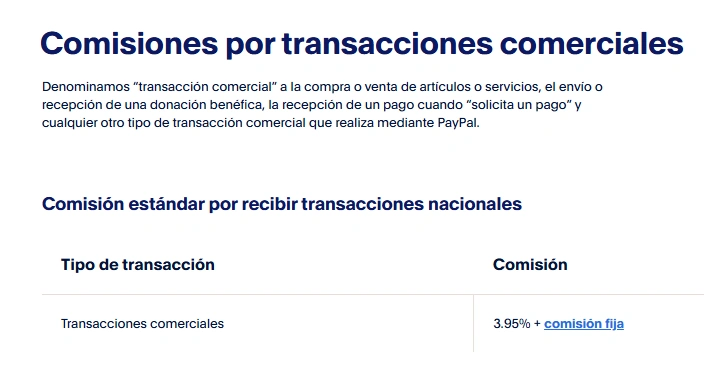
| Mexico | Standard commercial transactions | 3.95% + 4.00 MXN, plus IVA | Add 0.50 percentage points; IVA also applies |
| Brazil | Commercial transactions | 4.79% + 0.60 BRL | Add 1.61 percentage points |
The US Checkout row is not the direct Goods & Services rate. The US schedule separately lists domestic Send/Receive Money for Goods and Services at 2.99%, without a fixed fee. Match the actual receiving route before applying either price.
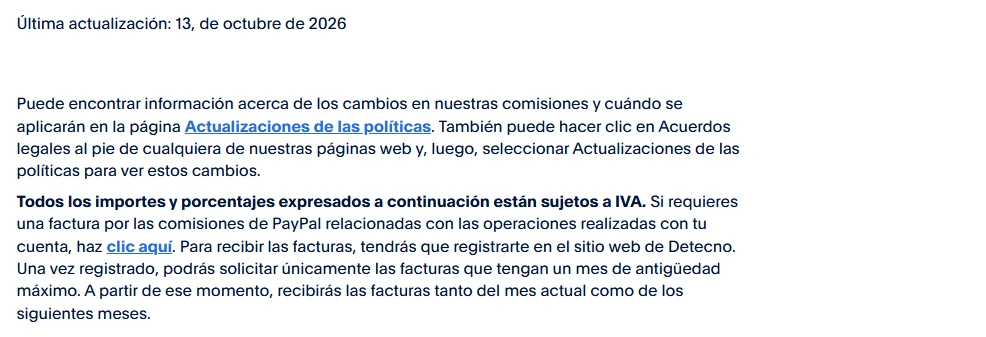
Mexico’s published fees are subject to IVA. Its table therefore should not be compared with a tax-inclusive quote as though both were final costs. The Mexican schedule flags this condition for its listed amounts and percentages.
United Kingdom, Germany and France
| Recipient’s account country | Selected payment category | Domestic receiving fee | International treatment |
|---|---|---|---|
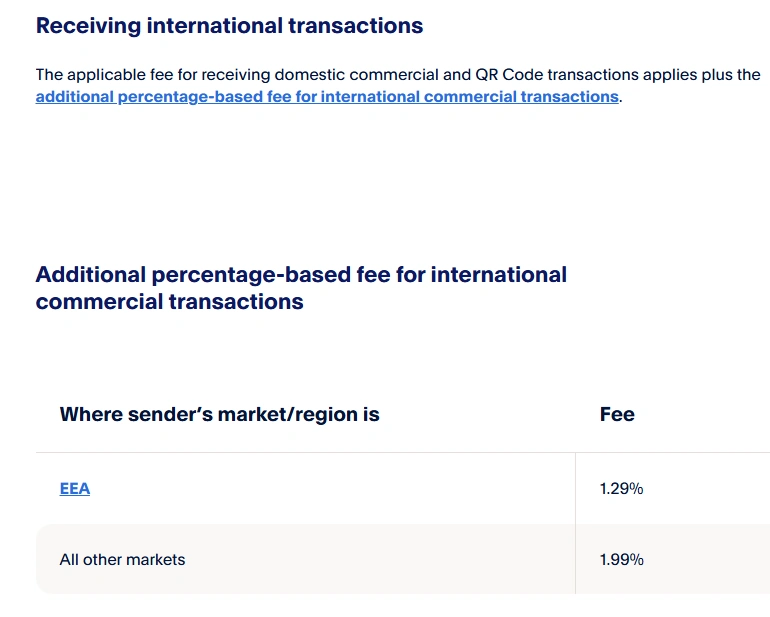
| United Kingdom | All Other Commercial Transactions | 2.90% + 0.30 GBP | From the EEA: add 1.29 points; other foreign markets: add 1.99 points |
| Germany | PayPal Checkout | 2.99% + 0.39 EUR | EEA: no addition; UK: add 1.29 points; other markets: add 1.99 points |
| France | All Other Commercial Transactions | 2.90% + 0.35 EUR | EEA: no addition; UK: add 1.29 points; other markets: add 1.99 points |
A lower rate elsewhere on the same page may describe a different product. For example, the UK’s 1.20% card-funded category applies under specific terms for payments without a PayPal account. It is not the general UK rate for all commercial receipts.
UK businesses should also check the effective policy notices. From October 1, 2026, PayPal introduced an optional domestic volume-tier plan that requires requesting enrollment, alongside changes to Pay Later pricing. The table uses the ordinary commercial rate, not an automatically assumed volume discount. See the UK fee amendments.
Australia, Japan, the Philippines and India
| Recipient’s account country | Selected payment category | Domestic receiving fee | International treatment |
|---|---|---|---|
| Australia | Online PayPal wallet transactions | 2.90% + 0.30 AUD | 3.90% + 0.30 AUD total |
| Japan | Standard commercial receipts | 3.60% + 40 JPY | Add 0.50 percentage points |
| Philippines | Standard commercial receipts | 3.40% + 15 PHP | 4.40% + 15 PHP total |
| India | International commercial receipts, shown in USD | Domestic receiving is not supported | 4.40% + 0.30 USD total; applicable taxes excluded |
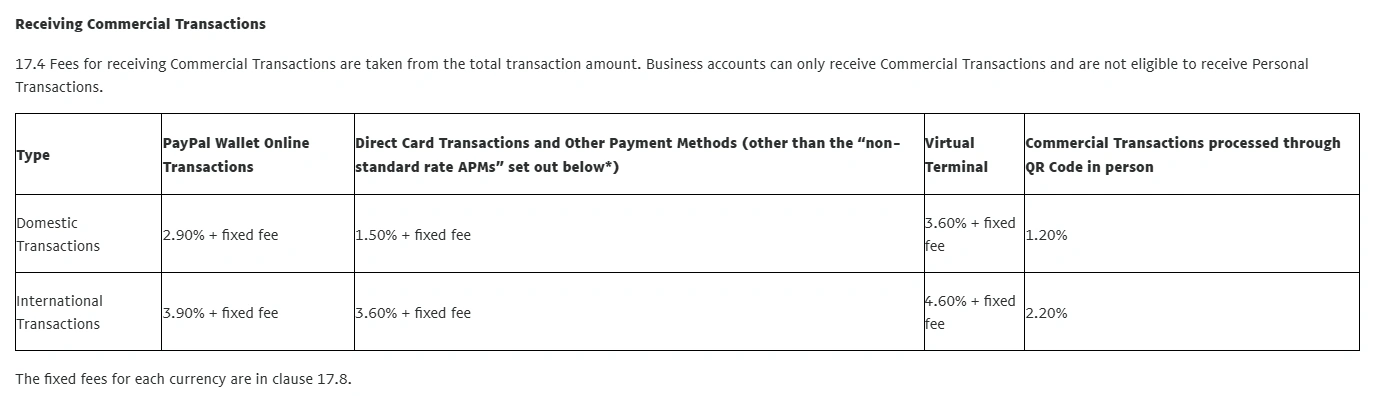
Australia’s merchant page gives its Combined Financial Services Guide and Product Disclosure Statement precedence where they conflict. The wallet rates above follow that disclosure. Check the applicable charge and tax treatment rather than assuming every Australian product uses the wallet rate.
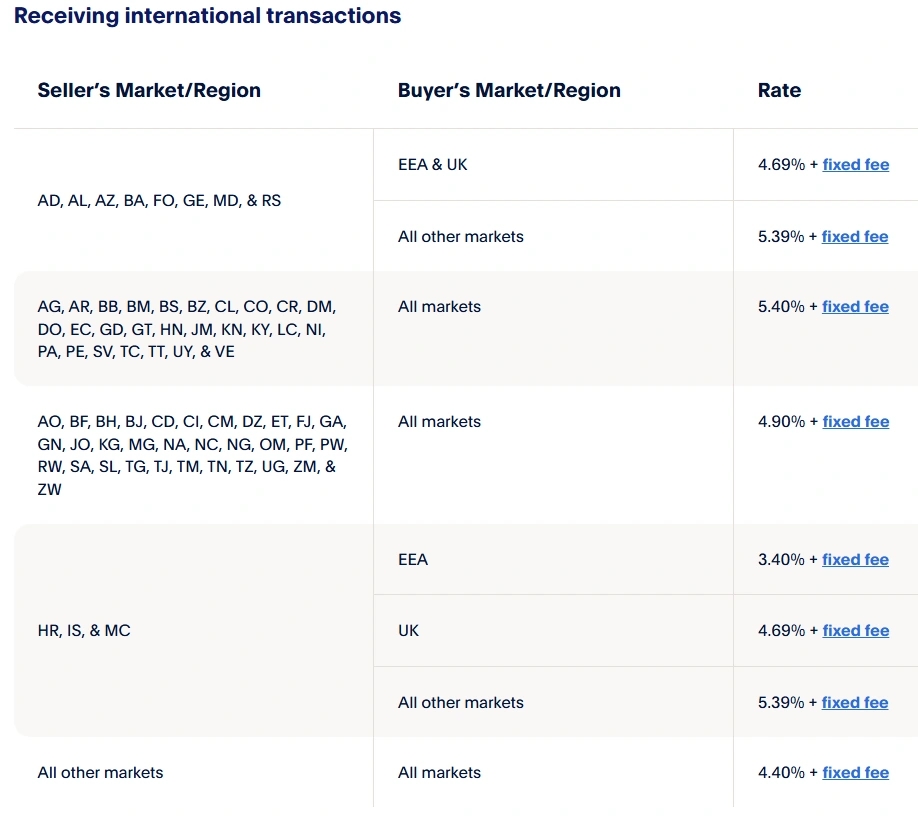
The Philippine schedule covers several markets in grouped tables. Its “all other markets” category places the Philippines at the rates shown above. The international 4.40% is the full percentage—not an additional 4.40% on top of 3.40%. Read the seller and buyer columns together.
Which country’s PayPal fee schedule applies?
For a commercial receiving fee, identify the recipient’s account market first, then the payment category and the sender’s relevant market. Canada’s schedule, for example, explicitly prices receipts differently depending on whether the sender is in the US or another foreign market. The Canadian recipient’s fee is therefore not determined by the sender’s US fee table.
If you are calculating a separate personal sending charge, use the sender’s consumer schedule instead. A transfer can involve different costs on the two sides; one party’s fee table does not establish the other party’s eventual bank receipt.
Receiving USD does not give every account US pricing
The receiving currency selects the relevant fixed charge within the applicable country and product schedule. For example, Canada’s commercial table lists a 0.30 USD fixed fee for USD receipts, while the US Checkout example uses 0.49 USD. Check the Canadian currency table against the US product table; the shared currency does not make those products or account markets identical.
Some different-country payments receive domestic treatment
For the selected German and French commercial categories, EEA payments have no additional cross-border percentage. Germany’s schedule explicitly treats qualifying EUR or SEK payments between EEA residents as domestic for fee purposes. Use the actual conditions in the German schedule rather than extending a regional exception to every currency or product.
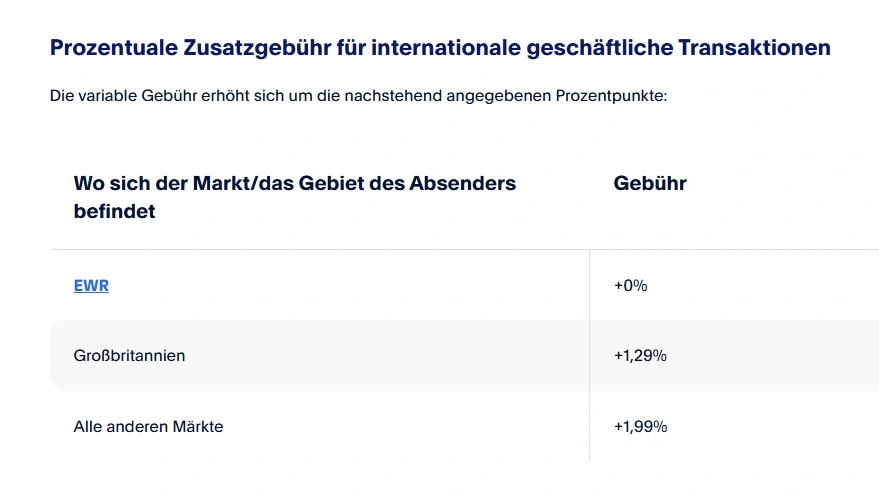
The UK schedule separately groups transactions between the United Kingdom, Guernsey, Jersey, and the Isle of Man as domestic. It also describes a service charge under separate merchant agreements; that is not an instruction to add another 1.29% to every ordinary EEA-to-UK receipt. See the UK regional and agreement-specific rules.
Examples: how country and payment direction change the fee
These are calculated illustrations, not personal transaction tests. They use the named standard products, exclude conversion, withdrawal, and any separately applicable taxes, and round estimated fees to the nearest cent with half cents rounded up. Actual billing conventions and account terms may differ.
The same 200 EUR amount in Germany and France
Consider two separate domestic EUR payments, each processed through the category shown in the country tables:
| Recipient and product | Calculation | Processing fee | Net after processing |
|---|---|---|---|
| Germany: PayPal Checkout | 200 × 0.0299 + 0.39 | 6.37 EUR | 193.63 EUR |
| France: other commercial transactions | 200 × 0.029 + 0.35 | 6.15 EUR | 193.85 EUR |
The difference is 0.22 EUR. It demonstrates why one “European PayPal fee” is insufficient; it does not establish that every French payment product is cheaper than every German one.
A 500 CAD receipt in Canada from different sender markets
| Sender’s market | Receiving rate | Fee on 500 CAD | Net after processing |
|---|---|---|---|
| Canada | 2.90% + 0.30 CAD | 14.80 CAD | 485.20 CAD |
| United States | 3.70% + 0.30 CAD | 18.80 CAD | 481.20 CAD |
| United Kingdom | 3.90% + 0.30 CAD | 19.80 CAD | 480.20 CAD |
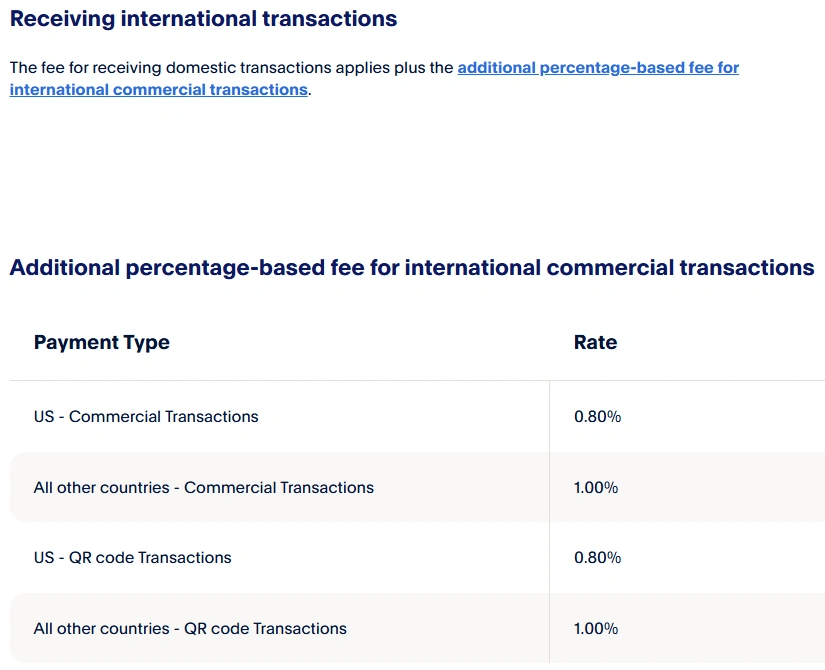
The Canadian account and receiving currency stay the same. Changing the sender’s market changes the applicable supplement. The table does not include any conversion or funding cost paid separately by the sender.
An international 1,000 USD receipt in India
Using India’s international commercial rate, a 1,000 USD payment from an overseas client gives:
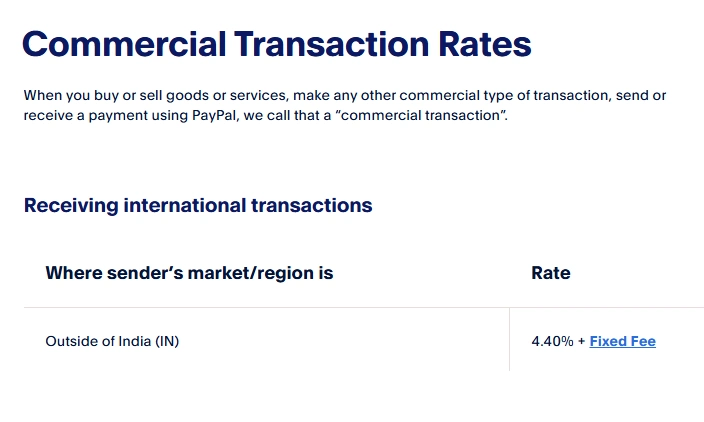
Processing fee = 1,000 × 0.044 + 0.30 = 44.30 USDAmount after that fee = 955.70 USD
This is a processing-stage calculation, not the final bank amount. India’s User Agreement excludes applicable taxes from its fees, and conversion can affect settlement. PayPal also automatically transfers Indian account balances to the preferred local bank each day; manual transfers are not available under that guidance.
Check payment availability before applying a price
“Not supported” is different from “free.” India’s merchant schedule limits the service to international payments. A domestic-receiving comparison should therefore show that restriction, not a zero fee or a rate borrowed from another country.
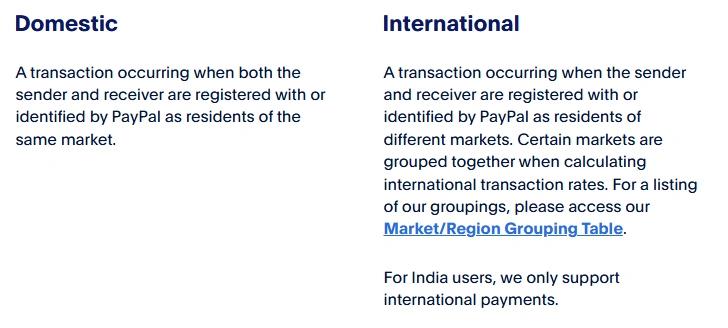
Also check what a long currency table actually describes. A fixed fee denominated in a currency does not, by itself, prove that every local account can receive, hold, and withdraw it through every product. The Indian schedule, for example, includes an INR fixed-fee entry while still stating that domestic payments are unsupported.
For grouped schedules, first read the applicable account-market list. Then match the recipient’s row and, where required, the buyer’s row. The Philippine merchant page is an example of a multi-market schedule: its fallback rows are not universal prices for countries outside that document’s scope.
Currency conversion and taxes can change the final cost
The commercial tables are receiving-fee references, not all-in transfer quotations. Before calculating a final amount, identify whether conversion occurs when the payment is funded, received, held, or withdrawn—and which party pays for it.
PayPal’s Australian disclosure explains that its transaction exchange rate already incorporates the conversion charge. Use the quoted rate once rather than converting an amount and then subtracting the same spread again. The applicable conversion category and rate still need checking for the account market; see the Australian conversion provisions.
Keep the tax notes beside the applicable prices in your own comparison. Mexico flags IVA on its published fees; Australia’s disclosure excludes GST unless expressly stated otherwise; and India’s agreement excludes applicable taxes. Those qualifications prevent the listed processing figures from being treated automatically as tax-inclusive totals.
A 100 USD payment, a 100 GBP payment, and a 100 JPY payment are not equal-value purchases. To compare equivalent economic amounts, use a common benchmark and a stated exchange rate, while keeping any actual PayPal conversion cost separate. A reference exchange rate used for comparison is not automatically the rate PayPal will quote.
Personal-transfer fees by country follow different rules
Do not apply the commercial receiving tables to a genuine personal transfer. These examples concern eligible personal payments funded by a PayPal balance or a linked local bank, without currency conversion. The international limits below apply to the specified sending component, not every possible cost.
| Sender’s account country | Eligible domestic personal payment | Standard international sending component |
|---|---|---|
| United States | No PayPal sending fee | 5%; minimum 0.99 USD, maximum 4.99 USD |
| United Kingdom | No PayPal sending fee | 5%; minimum 0.99 GBP, maximum 2.99 GBP |
| Australia | No PayPal sending fee | 5%; minimum 0.99 AUD, maximum 5.99 AUD |
Card-funding rules are not identical across these markets. The US schedule lists 2.90% plus a currency-based fixed fee for its ordinary card category, while Australia lists 2.60% plus a fixed fee. Do not copy either rule into a UK transfer without checking the UK schedule.
An ordinary purchase is another category. For example, the US consumer schedule lists purchases as free to the buyer when no conversion occurs. That does not eliminate the merchant’s receiving fee or establish the buyer’s rules in every other country.
Withdrawal fees also depend on the account country
Receiving a payment and moving an available balance to a bank are separate steps. These selected business-account bank-withdrawal examples assume an eligible destination and no currency conversion. They do not describe card withdrawals or every available payout route.
| Account country | Withdrawal scenario | Listed PayPal fee |
|---|---|---|
| United States | Standard transfer to an eligible linked bank | No fee without conversion |
| Mexico | Standard bank transfer; alternatively, eligible instant bank transfer | Standard: no fee; instant: 40 MXN plus IVA |
| Japan | Bank withdrawal of 10,000 JPY or 100,000 JPY | 10,000 JPY: 250 JPY fee; 100,000 JPY: no fee |
| Philippines | Local bank withdrawal of 5,000 PHP or 10,000 PHP | 5,000 PHP: 50 PHP fee; 10,000 PHP: no fee |
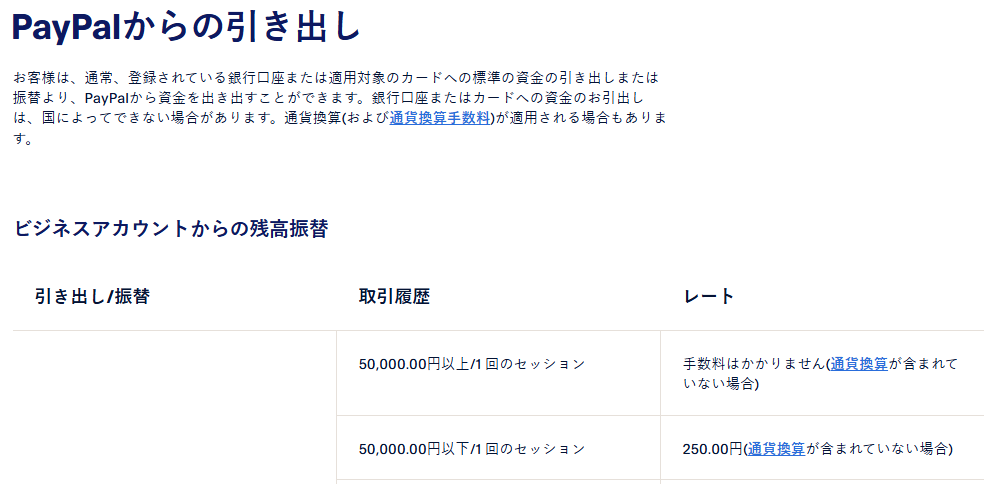
A zero withdrawal fee does not reverse the commercial fee already deducted from a sale. Likewise, a fee-free local-currency withdrawal does not establish a fee-free foreign-currency route. Calculate the receiving stage first, then any conversion and withdrawal using their actual amounts and currencies.
How to find the right fees for a country or product not listed
- Identify the action and the party charged. Decide whether you are calculating a seller’s receipt, a personal transfer, a purchase, a conversion, or a withdrawal.
- Open the relevant local PayPal fee page. Choose Consumer Fees or Merchant Fees as appropriate, then confirm the account markets covered by that page. Do not rely only on its language or currency list.
- Match the product and both sides of the transaction. Read the receiving category, sender-market conditions, and fixed-fee currency together. Determine whether an international number is an addition or a complete rate.
- Check effective notices and account-specific terms. A dated amendment may change one product without changing the rest of the fee table. Use the rates effective when the transaction occurs.
- Review the complete transaction. Add only the applicable conversion, tax, withdrawal, and other charges. For a completed payment, compare the same transaction and currency rather than an unrelated bank deposit.
The UK policy notices illustrate why effective dates matter: the optional tier plan and certain product changes took effect on October 1, 2026. A fee page’s older revision date does not mean every rate is obsolete, but it is a reason to inspect the linked updates before quoting a specific product.
Can you change your account country to obtain a lower rate?
Account country is not a pricing toggle. PayPal’s country-change guidance says you cannot edit an existing account’s address into another country. A genuine move requires following the applicable account-closing and new-account process, not merely choosing a different currency or website language.
Do not choose an account location from a fee table without establishing legitimate eligibility. A lower published percentage also says nothing by itself about the full conversion, tax, withdrawal, or operational cost of that setup.
The useful comparison is the fee for a supported transaction in your actual account market. Start with the linked country schedule, identify the payment product and receiving currency, then check the other party’s market and any additional costs. That produces a usable estimate without treating unlike countries, products, or currencies as interchangeable.
Last verified: October 19, 2026.