
Here is how to calculate PayPal fees manually: multiply the gross payment by the correct percentage rate, add any applicable fixed fee for the currency received, and round the result to the currency’s precision. Use zero when the relevant fee table lists no fixed fee. Subtract the fee from the payment to find the net payout. To work backward from a target payout, divide the target plus any applicable fixed fee by one minus the decimal rate, then verify the result after rounding.
This guide explains the forward and reverse PayPal fee formulas with current United States and United Kingdom merchant examples. Last verified: August 29, 2026. PayPal’s US and UK merchant fee pages were last marked updated on July 15, 2026. Public rates can change, and an account-specific agreement can override a standard rate.
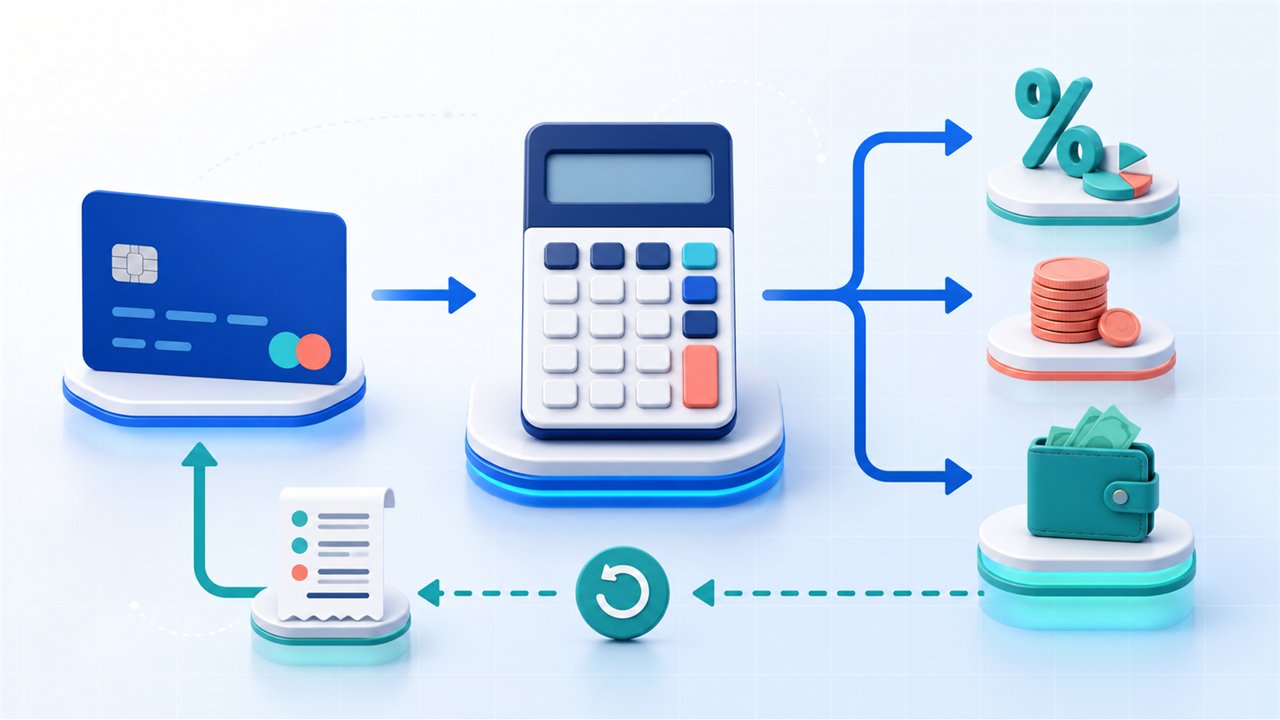
PayPal fee formulas at a glance
| Question | Formula |
|---|---|
| What is the PayPal fee? | Fee = round(gross × rate + fixed fee) |
| How much will I receive? | Net = gross − fee |
| How much should I request? | Raw gross = (target net + fixed fee) ÷ (1 − rate) |
| What is the effective fee rate? | Effective rate = fee ÷ gross × 100 |
In these formulas, gross is the amount the customer pays, rate is the applicable percentage written as a decimal, fixed fee is the amount listed for the currency received or zero when none applies, and net is the estimated amount left after the transaction fee.
On this page
What you need before calculating a PayPal fee
There is no universal “standard PayPal fee” for every payment. Select the inputs before doing the arithmetic:
- Merchant market: use the fee schedule for the country where the receiving PayPal account is registered.
- Payment route: Checkout, Goods and Services, standard cards, Pay Later, QR, invoices, and other products can use different percentages or fixed fees.
- Sender market: determine whether the customer is domestic or international. An international commercial add-on may apply.
- Currency received: choose the fixed fee for the currency that reaches the merchant balance, not simply the buyer’s location.
- Account agreement: check for negotiated, charity, micropayment, tiered, or other account-specific pricing.
For example, a US merchant receiving GBP generally starts with the US percentage for the payment route and uses the US fee table’s GBP fixed fee. A UK merchant receiving USD starts with the applicable UK percentage and uses the UK table’s USD fixed fee. For a broader product overview, see our guides to PayPal business fees for sellers and PayPal Goods and Services fees.
Rates used in the worked examples
This page uses a small set of rates only to demonstrate the math. It is not intended to duplicate PayPal’s full merchant fee schedules.
| Merchant and payment route | Current domestic rate used |
|---|---|
| US PayPal Checkout, receiving USD | 3.49% + $0.49 |
| US standard credit or debit card, receiving USD | 2.99% + $0.49 |
| UK All Other Commercial Transactions, receiving GBP | 2.90% + £0.30 |
| Qualifying UK card-funded payment from a user without a PayPal account | 1.20% + £0.30 |
Upcoming UK change: PayPal’s policy update says that from October 1, 2026, eligible UK merchants may request enrollment in an optional plan whose rate is determined by eligible commercial-transaction volume in the previous calendar month: 2.90% plus the fixed fee for £0–£4,000, 2.40% for more than £4,000 through £8,000, and 2.10% for more than £8,000. These are volume tiers, not a marginal-rate calculation. They are not current standard rates and should not be used before the effective date or without enrollment.
How to calculate PayPal fees from a known payment
The forward PayPal fee formula
Estimated fee = round(gross payment × decimal rate + fixed fee)
Estimated net = gross payment − estimated fee
- Confirm the correct percentage and whether a fixed fee applies.
- Convert the percentage into a decimal.
- Multiply the gross payment by that decimal.
- Add the applicable fixed fee once, or add zero when the table lists none.
- Round the result to the smallest unit supported by the currency.
- Subtract the rounded fee from the gross payment.
US example: $100 through PayPal Checkout
A US merchant receives a domestic $100.00 PayPal Checkout payment in USD. The public rate is 3.49% + $0.49.
- Convert 3.49% to
0.0349. - Percentage charge:
$100.00 × 0.0349 = $3.49. - Total fee:
$3.49 + $0.49 = $3.98. - Net payout:
$100.00 − $3.98 = $96.02.
The estimated fee is $3.98, and the merchant keeps an estimated $96.02.
US example: $250 standard card payment
For a domestic US standard card payment, use 2.99% + $0.49:
$250.00 × 0.0299 = $7.475.$7.475 + $0.49 = $7.965.- Rounded transaction fee: $7.97.
- Estimated net:
$250.00 − $7.97 = $242.03.
UK example: £100 commercial payment
A UK merchant receives a domestic £100.00 payment classified as an All Other Commercial Transaction. Use 2.90% + £0.30:
£100.00 × 0.029 = £2.90.£2.90 + £0.30 = £3.20.- Estimated net:
£100.00 − £3.20 = £96.80.
The estimated fee is £3.20, leaving an estimated £96.80.
How much should you request to receive a target amount?
Reverse calculation is useful when setting an all-in price or quote that must produce a specific net payout. Simply calculating the fee on the target and adding it back is mathematically wrong because the percentage applies to the larger gross amount that the customer pays.
Important: this calculation can help set an all-in price; it is not permission to add a PayPal-specific surcharge. PayPal’s US User Agreement prohibits a surcharge or other fee for accepting PayPal, and the UK User Agreement says sellers must not surcharge and notes that surcharging is strictly limited by law. Follow the agreement that governs your account and applicable local law.
The reverse PayPal fee formula
Raw gross = (target net + fixed fee) ÷ (1 − decimal rate)
Round the raw gross to valid currency precision, run the forward calculation on that amount, and check the resulting net. If it is one cent or penny below the target, increase the gross by one minor unit and verify again. This produces the smallest practical amount that reaches the target under the selected assumptions.
Receive exactly $100 after US Checkout fees
($100.00 + $0.49) ÷ (1 − 0.0349) = $104.123924...- Test a requested amount of $104.12.
- Estimated fee on $104.12: $4.12.
- Estimated net:
$104.12 − $4.12 = $100.00.
The common shortcut $100 + $3.98 = $103.98 would not work: the fee on $103.98 rounds to $4.12, leaving only $99.86.
Receive exactly £250 after UK commercial fees
(£250.00 + £0.30) ÷ (1 − 0.029) = £257.775...- Test a requested amount of £257.78.
- The estimated fee rounds to £7.78.
- Estimated net:
£257.78 − £7.78 = £250.00.
Check your manual calculation
Use the calculator below to verify the forward or reverse result. Select the merchant market, payment product, sender location, and received currency that match the transaction.
Estimate the fee, net amount, or the minimum amount to request. Choose the merchant market and the way the customer pays for a more relevant result.
- Payment amount
- —
- Percentage fee
- —
- International add-on
- —
- Fixed fee
- —
- Estimated total fee
- —
- Effective fee rate
- —
The calculator is an independent estimator based on public pricing. PayPal’s transaction details and your merchant agreement remain authoritative. Open the main PayPal Fee Calculator for more scenarios, or use the focused PayPal invoice fee calculator when an invoice payment is involved.
How to include an international commercial fee
For a standard percentage-based international add-on, combine it with the domestic percentage before using the same formula:
Combined rate = domestic product rate + international add-on
Fee = round(gross × combined rate + fixed fee)
| Example | Combined rate | Fee on 100 | Estimated net |
|---|---|---|---|
| US Checkout from an international sender | 3.49% + 1.50% = 4.99% | $5.48 | $94.52 |
| UK All Other Commercial Transaction from an EEA sender | 2.90% + 1.29% = 4.19% | £4.49 | £95.51 |
| UK All Other Commercial Transaction from another market | 2.90% + 1.99% = 4.89% | £5.19 | £94.81 |
The same reverse formula works after replacing the domestic rate with the correct combined rate. For country groupings, exceptions, and additional examples, use our dedicated guide to PayPal international transaction fees.
Transaction fees and currency conversion are separate
Do not automatically add a currency-conversion percentage to the commercial transaction formula. First calculate the processing fee in the currency received. If PayPal then converts the balance, use the actual transaction exchange rate displayed by PayPal.
PayPal’s US merchant page currently lists a 4.00% spread for certain purchase, personal-payment, and Payouts conversions and 3.00% for other conversions, or another amount disclosed during the transaction. The UK page lists 3% above the base exchange rate for the business-account conversion case it describes. The exchange rate changes over time, so a static manual formula cannot reproduce every currency-conversion result.
PayPal fee formulas for Excel or Google Sheets
Place the gross payment or target net in cell A2, the decimal rate in B2, and the fixed fee in C2.
| Output | Spreadsheet formula |
|---|---|
| Estimated fee from gross | =ROUND((A2*B2)+C2,2) |
| Estimated net from gross | =A2-ROUND((A2*B2)+C2,2) |
| Raw gross for target net | =(A2+C2)/(1-B2) |
| Gross rounded upward for verification | =ROUNDUP((A2+C2)/(1-B2),2) |
| Effective fee rate | =ROUND(ROUND((A2*B2)+C2,2)/A2*100,2) |
Why the effective rate is higher on small payments
The percentage scales with the payment, but the fixed fee is charged once per transaction. At the US Checkout example rate of 3.49% + $0.49, the fixed $0.49 has a much larger effect on a $10 payment than on a $1,000 payment.
| Customer pays | Estimated fee | Estimated net | Effective rate |
|---|---|---|---|
| $10.00 | $0.84 | $9.16 | 8.40% |
| $25.00 | $1.36 | $23.64 | 5.44% |
| $50.00 | $2.24 | $47.76 | 4.48% |
| $100.00 | $3.98 | $96.02 | 3.98% |
| $250.00 | $9.22 | $240.78 | 3.69% |
| $1,000.00 | $35.39 | $964.61 | 3.54% |
Repeated fixed fees also make split payments more expensive under this example. Six separate $100 Checkout payments produce about $23.88 in total estimated fees, while one $600 payment produces about $21.43. Actual business and customer needs may still require installments, deposits, or staged invoices.
How to handle rounding correctly
- Keep the full decimal result until the fee calculation is complete.
- Round the estimated fee to the smallest valid unit for the received currency.
- Do not assume every currency uses two decimal places; JPY, for example, uses whole-unit precision in PayPal’s API guidance.
- For reverse calculations, recalculate the fee and net after rounding the gross amount.
- Treat a one-cent difference as a signal to check the payment route, fixed fee, rounding order, and account-specific pricing.
PayPal does not publish one general half-cent rule on the merchant fee pages used for this guide. The calculations here are estimates, and the completed transaction record controls. See how PayFeeCalc applies rates and rounding for the calculator’s methodology.
Why the actual PayPal fee may be different
- The payment used a different product route than expected.
- The sender was international or belonged to a different PayPal market grouping.
- The received currency used a different fixed fee.
- PayPal converted currency using the transaction exchange rate.
- The account has negotiated, charity, micropayment, tiered, or legacy pricing.
- An invoice, platform, marketplace, or commerce system added another fee.
- Tax, shipping, or another checkout amount increased the gross payment on which the percentage was charged.
- Refund, dispute, chargeback, or withdrawal costs were confused with the transaction fee.
Common manual calculation mistakes
- Using an old “2.9% + $0.30” shortcut: US PayPal pricing now distinguishes between Checkout, standard cards, Goods and Services, Pay Later, QR, invoices, and other routes.
- Multiplying by 3.49 instead of 0.0349: divide the percentage by 100 before multiplying.
- Choosing the rate from the currency alone: the percentage begins with the receiving account’s market and payment product.
- Adding the fixed fee twice: a percentage-plus-fixed formula normally adds it once per transaction.
- Adding the forward fee to a target net: use the reverse formula because the percentage is calculated on the gross request.
- Combining the cross-border fee and currency conversion automatically: they are separate costs and conversion may not occur.
- Skipping the final reverse check: rounding can leave the result one cent or penny short.
When the standard formula is not enough
The percentage-plus-fixed formula covers many commercial transaction estimates, but it does not automatically model capped ACH fees, micropayment pricing, charity eligibility, interchange-plus card processing, personal transfers, Payouts, Pay with Crypto, chargebacks, disputes, refunds, instant withdrawals, or changing currency-conversion rates. Use the product-specific fee table and your account agreement when one of those conditions applies.
Frequently asked questions
What is the formula for calculating PayPal fees manually?
Multiply the gross payment by the decimal percentage rate, add any applicable fixed fee, and round the result to the currency’s precision. Use zero when the relevant fee table lists no fixed fee. Then subtract the fee from the gross payment to estimate the net payout.
How do I calculate how much to request after PayPal fees?
Use (target net + fixed fee) ÷ (1 − decimal rate). Round the gross to valid currency precision, calculate the fee again, and increase the request by one cent or penny only if the verified net is below the target.
How much is the PayPal fee on $100?
It depends on the product. For a domestic US PayPal Checkout payment received in USD, the current public rate produces a $3.98 fee and $96.02 net. A standard domestic card route produces a $3.48 fee. A direct Goods and Services route has a different published price. Confirm which payment type was actually used.
How much should I request to receive $100 after PayPal fees?
At the current domestic US PayPal Checkout example rate of 3.49% + $0.49, request an estimated $104.12 to net $100.00. Another product, market, sender location, currency, or account agreement produces a different result.
Which currency determines the fixed PayPal fee?
The fixed commercial-transaction fee is selected from the merchant fee table based on the currency received. The merchant market and payment route determine the applicable percentage schedule.
Does the same formula work for an international payment?
Yes, when the international cost is an added percentage. Combine the domestic product percentage with the applicable international add-on, then use the same forward or reverse formula. Currency conversion is separate and should use PayPal’s displayed transaction exchange rate.
Can I use this formula for PayPal invoices?
The math works for an invoice payment that uses a percentage-plus-fixed rate, but the percentage must match the customer’s invoice payment method. In US invoicing, Checkout, standard cards, Pay Later, and Pay by Bank do not share one price.
Does the manual formula include currency conversion?
No. The formulas on this page estimate the transaction fee. If PayPal converts currency, use the exchange rate and conversion spread disclosed for the transaction after calculating the processing fee in the appropriate received currency.
Why is my result one cent different from PayPal?
A one-cent difference can come from rounding order, currency precision, or a different fixed fee. A larger difference usually points to the wrong payment product, an international add-on, currency conversion, account-specific pricing, or another platform fee.
Sources and methodology
- PayPal US Merchant Fees — last updated July 15, 2026.
- PayPal UK Merchant Fees — last updated July 15, 2026.
- PayPal UK Policy Updates — includes changes scheduled for October 1, 2026.
- PayPal US User Agreement and PayPal UK User Agreement — surcharge rules.
- PayPal API currency precision guidance.
PayFeeCalc is an independent fee-estimation resource and is not affiliated with, endorsed by, or sponsored by PayPal. “PayPal” is a trademark of its respective owner. Estimates use public standard pricing and the assumptions shown; PayPal’s live pricing, transaction record, and account agreement control.