
Choose a PayPal Personal account when you mainly shop online, send genuine personal payments, split expenses, or sell items only occasionally. Choose a PayPal Business account when accepting customer payments is a regular part of your work or you need tools such as invoices, checkout integrations, payment links, a business name, or controlled access for team members.
You can also maintain one Personal account and one Business account when you need to separate personal transfers from commercial activity. PayPal currently requires a different email address for each account, while eligible account holders can link the two accounts for easier switching without combining their balances, histories, or permissions.
Last verified: October 19, 2026.
PayPal Personal vs Business Account at a glance
| Decision factor | PayPal Personal | PayPal Business |
|---|---|---|
| Primary purpose | Shopping, personal transfers, gifts, shared expenses, and occasional selling | Regular business or commercial activity |
| Best suited to | Consumers and casual sellers | Freelancers, sole proprietors, creators, merchants, organizations, and companies |
| Receiving sales payments | Suitable for occasional sales where permitted | Designed for recurring customer payments |
| Account name | Uses the account holder’s personal identity | Can operate under a company, group, or business name, subject to verification |
| Business payment tools | More limited than a Business account | May include Checkout, invoices, payment links, QR codes, subscriptions, and merchant tools |
| Team access | No equivalent multi-user business permission system | Supports secondary users and controlled permissions in eligible markets |
| Personal payments | Designed for eligible personal transfers between friends and family | Personal-payment availability is restricted; U.S. Business accounts cannot receive Friends and Family payments |
| Fees | Depend on the transaction type, funding source, country, currency, and withdrawal method | Depend on the payment product, transaction type, market, currency, and optional services |
| Best overall use | Personal activity with only occasional selling | Ongoing commercial activity or access to merchant tools |
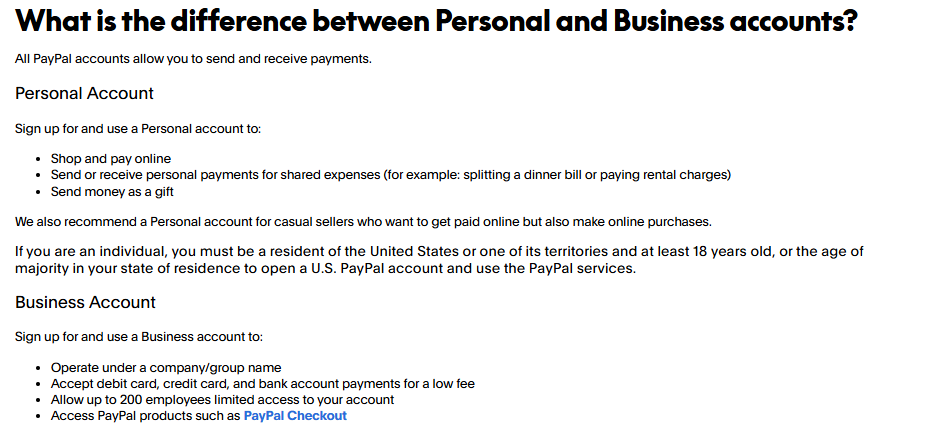
The main difference is the account’s purpose, not simply how much money passes through it. PayPal recommends Personal accounts for shopping, personal transfers, and casual selling. Its current U.S. User Agreement requires a Business account when the account is established primarily for business or commercial activity, even when the business is not incorporated.
The deciding question: what will you mainly use PayPal for?
Your account type should match its primary purpose. Occasional selling does not automatically make every user a business, but repeatedly accepting payments from clients, customers, subscribers, or ecommerce buyers is commercial activity rather than personal use.
Choose Personal for personal payments and casual selling
A Personal account is usually the better fit when you mainly buy online, reimburse friends, divide household costs, send gifts, or occasionally sell an unwanted item. PayPal’s U.S. account guidance specifically includes casual sellers among the users who may prefer a Personal account.
Occasional selling still involves a commercial payment. A buyer paying for an item or service should use the Goods and Services payment type rather than Friends and Family.
Choose Business for regular commercial activity
A Business account is the stronger choice when you repeatedly invoice clients, accept customer payments, sell through a website or social media, operate under a trading name, collect eligible donations, or need another person to access selected account functions.
Do not wait for an arbitrary revenue level before changing account types. Under PayPal’s current U.S. agreement, the relevant question is whether the account is used primarily for business or commercial activity. PayPal may require a Personal account used mainly for commercial purposes to stop that activity or convert to a Business account.
Do you need an LLC or registered company for PayPal Business?
No, a formal company is not always required. Freelancers, creators, independent contractors, and sole proprietors can use a PayPal Business account. PayPal’s U.S. agreement states that primarily commercial activity requires a Business account even when the business is not incorporated.

You must still provide accurate information about yourself and your activity. Depending on the country and legal structure, PayPal may request the owner’s legal name, address, date of birth, taxpayer identification number, business name, registration details, supplier information, invoices, bank statements, or other verification documents.
Opening a PayPal Business account does not create an LLC, corporation, partnership, or separate legal entity. It also does not provide liability protection by itself. Business registration, licences, tax registration, and legal structure are separate matters governed by the rules where you operate.
Are PayPal Business fees higher than Personal fees?
Not automatically. The cost often depends more on the type of payment and how it is processed than on whether the account is labelled Personal or Business.
PayPal does not currently charge a fee to open an account in the United States. That does not make every transaction free. Commercial payments, card processing, international activity, currency conversion, instant withdrawals, disputes, chargebacks, and optional merchant products can have separate fees.
| Cost question | What usually determines the answer |
|---|---|
| Does opening the account cost money? | PayPal currently charges no account-opening fee in the U.S.; check the local terms for your country |
| Is a personal transfer free? | Country, funding source, currency, and whether the transfer is domestic or international |
| What does receiving a customer payment cost? | Payment channel, merchant product, buyer location, currency, and local commercial fee schedule |
| Will currency conversion add a cost? | The currencies involved and whether PayPal performs the conversion |
| Does withdrawing money cost anything? | Country, withdrawal destination, and standard versus instant transfer |
| Can a dispute create another fee? | Transaction type, dispute or chargeback outcome, protection eligibility, and local terms |
To estimate your actual cost, identify five details before comparing rates: your account country, how the customer pays, where the customer is located, which currency is used, and how you plan to withdraw the money. Then consult PayPal’s current consumer or merchant fee page for that market instead of relying on a single percentage quoted in an old comparison article.
A Personal account does not make commercial sales fee-free, and a Business account does not necessarily have a monthly subscription charge. Optional merchant products may have separate pricing, so distinguish the standard account from the specific payment product you intend to use.
What extra features does a Business account provide?
A Business account becomes valuable when you need a repeatable way to collect, manage, and document commercial payments rather than simply a place to receive money.
- Business-name presentation: You can use a company, group, or business name, subject to PayPal’s naming and verification requirements.
- Checkout tools: Eligible businesses can integrate PayPal Checkout and supported card, bank, or digital-wallet payment methods.
- Professional invoices: You can create and send invoices, track their status, and let eligible customers pay through supported methods.
- Payment links and QR codes: Supported businesses can create hosted payment pages, share payment links, or display QR codes without building a full ecommerce website.
- Recurring and product-specific payments: Subscriptions, Virtual Terminal, point-of-sale tools, and other products may be available depending on the market and account.
- Controlled team access: The primary owner can create separate user access and assign selected permissions instead of sharing the main login.
- Reporting tools: Business users can access transaction history, downloadable reports, and product-specific reporting where available.
PayPal’s current U.S. guidance states that Business accounts can provide limited access to as many as 200 employees and access to products such as PayPal Checkout. Individual features, accepted payment methods, eligibility requirements, and prices can differ by country or product.

Does PayPal Business hide your real name?
No. A Business account can allow you to operate under a company or business name, but it should not be treated as an anonymous account or a method of avoiding identity disclosure.
PayPal verifies the account owner and may request identity, address, tax, banking, or business documentation. The information a customer sees can also vary between a checkout page, invoice, business profile, payment request, email notification, transaction record, dispute, and card statement.
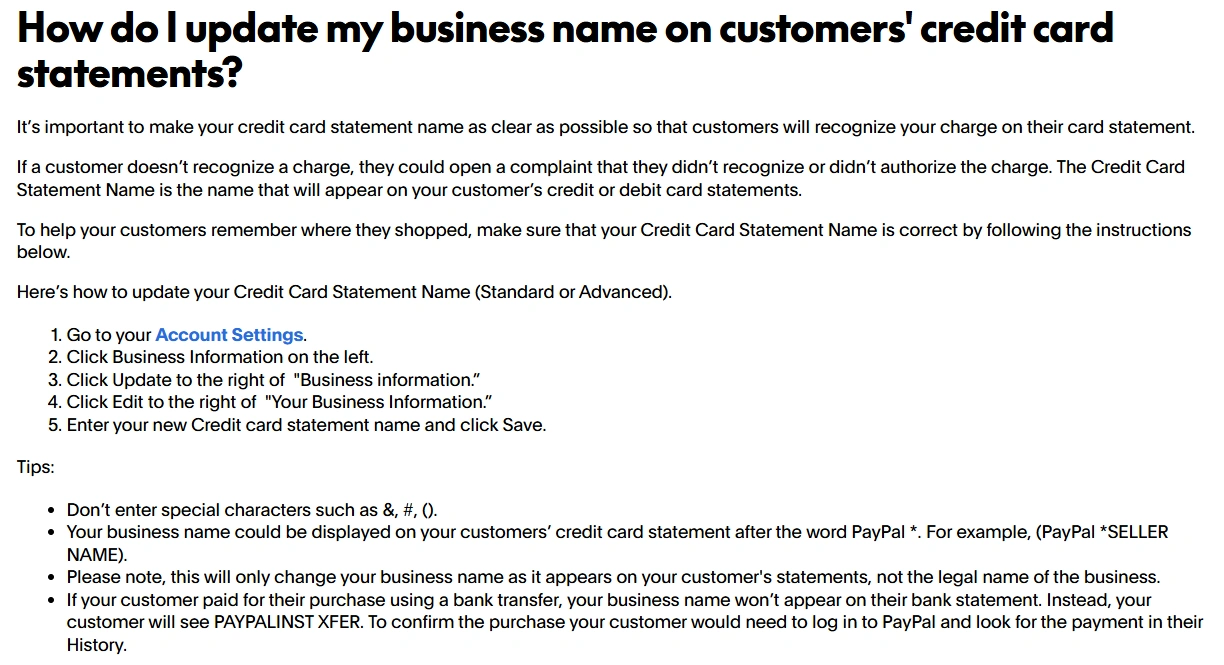
U.S. Business accounts can configure a customer-facing credit card statement name. Changing that descriptor does not change the legal name of the business. Before accepting live payments, preview your invoice, payment link, checkout page, business profile, and statement descriptor so customers can recognize the charge.
Account type and payment type are not the same thing
A Personal account does not turn every payment into a personal transfer, and a Business account does not change a sale into a different transaction category. Each payment should be classified according to its real purpose.
Friends and Family payments
Friends and Family is intended for genuine personal exchanges, such as gifts, shared meals, household expenses, or reimbursements. It is not intended for purchases, freelance work, deposits, products, commissions, subscriptions, or services.
Goods and Services payments
Goods and Services is the appropriate classification when someone is paying for an item or service. Commercial fees may apply, and eligible transactions may qualify for PayPal protection subject to the applicable terms.
Never ask a customer to use Friends and Family to avoid a commercial fee. Personal payments are not covered by PayPal Purchase Protection. In addition, U.S. Business accounts cannot receive Friends and Family payments from U.S. senders.
Does a Business account provide better protection?
A Business account does not automatically make every transaction protected. Buyer and Seller Protection depend on the transaction, item, payment method, account standing, available evidence, delivery records, deadlines, and current country-specific program terms.
PayPal’s U.S. Purchase Protection terms exclude personal payments, including payments sent through Friends and Family. Seller Protection applies only to eligible transactions that meet PayPal’s evidence, delivery, response, and account requirements.
Check the Transaction Details page to see whether a particular payment is marked as eligible or partially eligible. Do not assume that choosing a Business account guarantees reimbursement after a dispute, reversal, or chargeback.
Regular sellers should retain invoices, customer messages, item descriptions, tracking records, proof of delivery, refund documentation, and evidence showing when digital goods or services were supplied. These records are more useful during a dispute than choosing Business solely because it sounds safer.
Does the account type change your taxes?
No. The Personal or Business label does not determine whether income is taxable. Tax treatment depends on what the payment represents, your circumstances, and the law that applies in your jurisdiction.
A Personal account used to receive payments for goods or services may still create tax and reporting obligations. Likewise, opening a Business account does not make every incoming transfer taxable business income. Keep personal reimbursements separate from sales and maintain records explaining the purpose of each transaction.
For U.S. federal reporting, third-party settlement organizations generally must issue Form 1099-K when payments for goods or services exceed $20,000 and the number of transactions exceeds 200 during the calendar year. A form may still be issued below that federal threshold because of state rules, card-payment reporting, backup withholding, or the payment platform’s practices.
The reporting threshold does not determine whether income is taxable. U.S. taxpayers must report taxable income even when they do not receive Form 1099-K. These rules are U.S.-specific and can change, so consult the relevant tax authority and a qualified tax professional for advice about your circumstances.
Which PayPal account is best for your situation?
| Your situation | Usually the better choice | Reason |
|---|---|---|
| Shopping and splitting bills | Personal | The account is being used mainly for personal purposes |
| Selling an unwanted item occasionally | Personal | PayPal recommends Personal for casual sellers; classify the sale as Goods and Services |
| Freelancing or consulting regularly | Business | Client payments are recurring commercial activity, and invoicing may be useful |
| Creator accepting commissions or customer payments | Business | The payments relate to work, products, memberships, or services |
| Sole proprietor without an LLC | Business | Incorporation is not required for an account used primarily for commercial activity |
| Ecommerce store or marketplace seller | Business | Checkout, customer payments, transaction records, and merchant tools are central |
| Company with employees or an accountant | Business | Secondary users and permissions reduce the need to share the primary credentials |
| Business owner who also sends personal reimbursements | One of each | Separate accounts keep personal transfers and commercial activity distinct |
These recommendations follow PayPal’s distinction between primarily personal activity, casual selling, and primarily commercial activity. Your local PayPal agreement and the products available in your country remain controlling.
Should you upgrade or open a second account?
Upgrade your existing Personal account when its purpose has permanently changed and you no longer need it primarily for personal transfers. Open a separate Business account when you want to preserve a dedicated Personal account for shopping, gifts, and genuine Friends and Family payments.
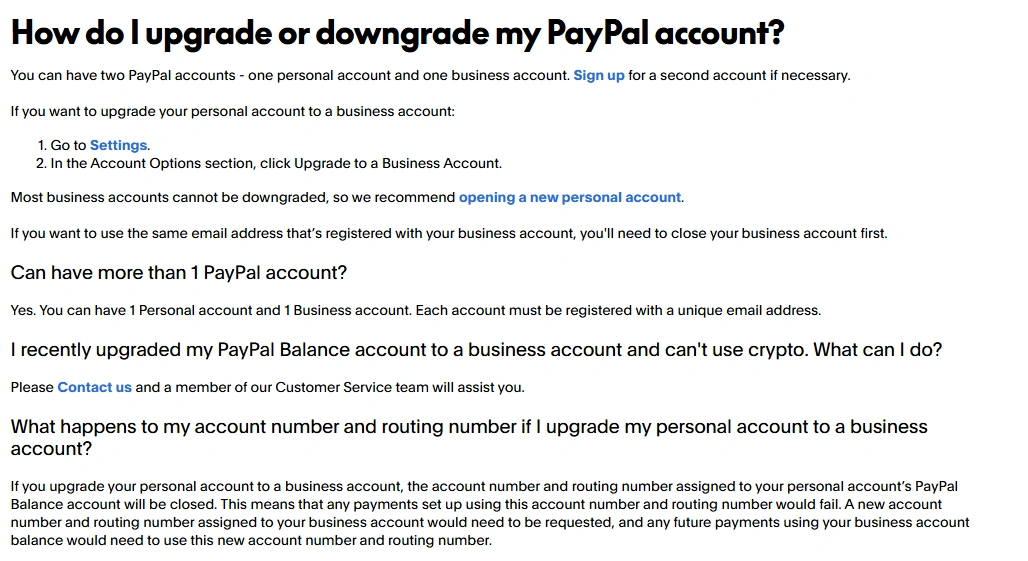
PayPal currently permits one Personal account and one Business account in the United States, with a unique email address for each. Eligible primary account holders can link their Personal and Business accounts and switch between them without logging out, while keeping their balances, transaction histories, security, privacy, and user permissions separate.

How to upgrade Personal to Business
- Sign in to PayPal through a web browser.
- Open Settings.
- Find the Account Options section.
- Select Upgrade to a Business Account.
- Enter the requested personal, business, and tax information accurately.
- Complete any identity or business-verification steps requested by PayPal.
Review linked products and payment details before upgrading. PayPal’s U.S. Help Center warns that upgrading a Personal PayPal Balance account can close its existing account and routing numbers. Payments sent to those old details may then fail until new Business account details are requested and used.
Can you downgrade Business to Personal?
Most Business accounts cannot be downgraded through a simple account setting. PayPal generally recommends opening a new Personal account instead. To reuse an email address currently attached to the Business account, you may need to remove it or close the Business account first.
Before closing an account, resolve pending transactions, disputes, limitations, negative balances, subscriptions, and withdrawals. Contact PayPal Support when the account cannot be changed or closed through the available settings.
Common mistakes to avoid
- Using Personal for an ongoing business: Repeated customer payments can make the account primarily commercial even when revenue is still modest.
- Using Friends and Family for sales: It misclassifies the payment and excludes the personal payment from Purchase Protection.
- Assuming Business is anonymous: PayPal still verifies the account owner and may display different identifying information throughout the payment process.
- Comparing only one headline fee: Cross-border, currency-conversion, withdrawal, dispute, and product fees may change the total cost.
- Mixing personal and business records: Separate accounts and accurate payment classifications make bookkeeping and tax preparation easier.
- Sharing the primary password: Use Business account user permissions for employees, developers, or bookkeepers when available.
- Upgrading without checking the consequences: Review downgrade restrictions and linked balance, routing, subscription, or merchant features first.
- Assuming the account creates a legal business: PayPal account type and legal business structure are separate decisions.
Frequently asked questions
Is a PayPal Business account free?
Opening a PayPal account is currently free in the United States, but commercial transactions, optional products, currency conversion, instant withdrawals, disputes, and other services may carry fees. Check the current Business fee schedule for your country and payment product.
Can I use a Personal PayPal account for business?
A Personal account may suit occasional selling, but it should not be used primarily for ongoing commercial activity. PayPal’s U.S. agreement requires a Business account when business or commercial use is the account’s primary purpose.
Do I need an LLC or EIN for PayPal Business?
You do not necessarily need an LLC because sole proprietors and unincorporated businesses can use Business accounts. The tax number and documents requested depend on your country, legal structure, account activity, and verification status.
Can I have both Personal and Business PayPal accounts?
Yes. PayPal currently permits one Personal account and one Business account in the United States. Each account must use a different email address, and eligible primary account holders can link the accounts for easier switching.
Does a Business account hide my real name?
No. A Business account can present a business or company name, but PayPal still verifies the account owner. The information visible to customers can vary between invoices, checkout pages, profiles, transaction records, disputes, emails, and payment statements.
Does a Personal account avoid merchant fees?
No. Receiving payment for a product or service remains a commercial transaction even when the recipient uses a Personal account. The applicable fee depends on the payment type and local fee schedule, not on asking the customer to classify the sale as Friends and Family.
Can a Business account receive Friends and Family payments?
U.S. Business accounts cannot receive Friends and Family payments from U.S. senders. Rules may differ in other markets, but commercial purchases should always be classified as payments for goods or services.
Can I change a Business account back to Personal?
Most Business accounts cannot be downgraded directly through account settings. PayPal generally recommends opening a new Personal account, while account-specific cases may require assistance from PayPal Support.
The final decision
Choose Personal when PayPal is mainly for your purchases, gifts, shared expenses, and occasional selling. Choose Business when you regularly receive customer payments, present a business identity, invoice clients, connect checkout tools, or share controlled access with a team.
Keep both when you have legitimate personal-payment needs alongside commercial activity. The cleanest arrangement is usually a Personal account for personal transfers and a Business account for sales, services, and customer payments, with each transaction classified accurately and supported by clear records.
Sources checked
- PayPal: Difference between Personal and Business accounts
- PayPal U.S. User Agreement
- PayPal: Account fee guidance
- PayPal U.S. merchant and Business fees
- PayPal: Friends and Family versus Goods and Services
- PayPal: Upgrading or downgrading an account
- PayPal: Linking Personal and Business accounts
- PayPal U.S. Seller Protection terms
- PayPal U.S. Purchase Protection terms
- IRS: Understanding Form 1099-K