
Stripe’s standard online card rate is lower than PayPal’s standard card and wallet Checkout rates, but PayPal’s advanced card-processing rate is slightly lower than Stripe’s. Invoicing, subscription software, and the payment method can change the result. Compare the products in Stripe’s US pricing and PayPal’s business pricing, rather than assuming one brand is always cheaper.
This PayPal vs Stripe fees comparison covers US businesses and USD. Examples use published standard pricing, not negotiated contracts, promotional offers, or personal-account fees. They are calculated illustrations, not transaction tests. Fees are rounded to the nearest cent, with half cents rounded up, for these estimates; actual billing conventions may differ. Net after processing is not business profit or guaranteed available cash.
Table of Contents
PayPal vs Stripe fees: online payments at a glance
For a successful $100 domestic online payment, the processing-only comparison is:
| Payment product | Domestic US rate | Fee on $100 | Net after processing |
|---|---|---|---|
| Stripe standard online cards | 2.9% + $0.30 | $3.20 | $96.80 |
| PayPal standard cards | 2.99% + $0.49 | $3.48 | $96.52 |
| PayPal Expanded Checkout: advanced cards, flat-rate pricing | 2.89% + $0.29 | $3.18 | $96.82 |
| PayPal wallet Checkout | 3.49% + $0.49 | $3.98 | $96.02 |
Stripe saves $0.28 against PayPal standard cards and $0.78 against wallet Checkout in this example. Against PayPal’s advanced-card rate, Stripe costs $0.02 more. That small difference is a reason to examine your existing setup before paying to replace it.
The customer’s funding source does not, by itself, identify your processing product. A card used inside a PayPal wallet payment does not automatically receive the standalone card-processing rate. PayPal’s Checkout comparison separates wallet payments from its card products and explains their different checkout and risk-management responsibilities.
The direct Send/Receive Money for Goods and Services route is another category, listed at 2.99% for domestic payments in the merchant schedule. It is not a universal substitute for a store’s checkout, invoice, or subscription rate.
Do either of the basic setups require a monthly fee?
Stripe’s standard Payments pricing has no setup or monthly fee, and its ordinary Checkout and Payment Links interfaces are included with standard processing. PayPal also advertises no setup or monthly fee for its basic Checkout offerings. See Stripe’s included services and PayPal Checkout pricing.
That does not make every additional service free. Compare only the software, integrations, fraud tools, and subscriptions you actually need. A gateway-only charge, a marketplace plan, or a similarly named legacy product should not be added automatically to these examples.
Invoice fees: include the software charge
Stripe Invoicing adds a software charge to payment processing: 0.4% per paid one-time invoice on Starter, or 0.5% on Plus. These charges are separate from subscription Billing. PayPal’s basic invoice creation and sending are free, while collecting the invoice incurs its applicable payment fee. Sources: Stripe Invoicing pricing and PayPal Invoicing.
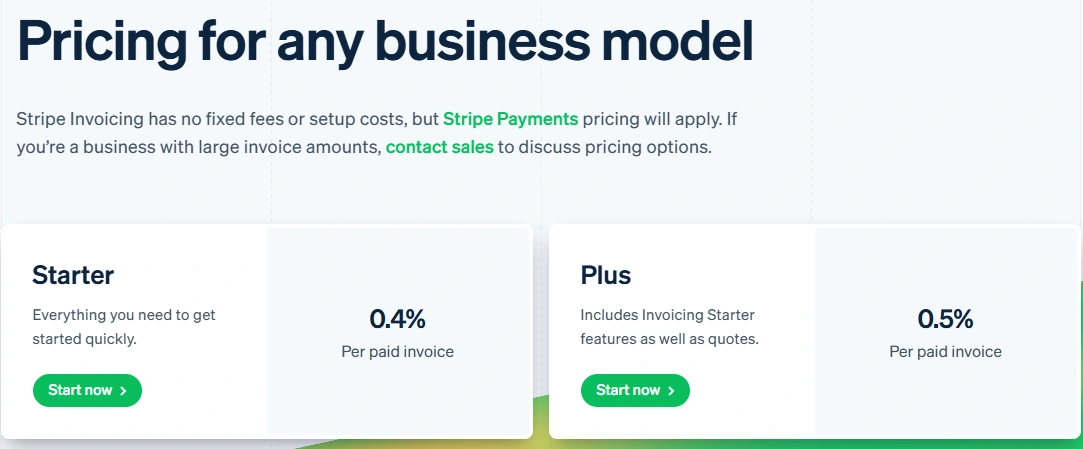
For one $1,000 domestic invoice paid online, the difference is:
| Invoice setup | Processing fee | Invoice software charge | Total |
|---|---|---|---|
| Stripe Invoicing Starter, domestic card | $29.30 | $4.00 | $33.30 |
| PayPal basic invoice, standard card | $30.39 | $0.00 | $30.39 |
| PayPal basic invoice, wallet Checkout | $35.39 | $0.00 | $35.39 |
Stripe’s lower base card rate does not win the standard-card invoice comparison. Invoicing Starter takes its total $2.91 above PayPal’s card-paid invoice. Against the wallet-paid invoice, however, Stripe is $2.09 cheaper.
PayPal’s result depends on the method selected from the options available to the customer. Its Invoicing Terms govern that selection and any separate Invoice Subscription Service. The examples do not assume that every account offers every method or requires an optional subscription.
A post-payment invoice is a different Stripe feature
Stripe separately prices optional invoice generation after a one-time Checkout or Payment Links purchase at 0.4%, capped at $2 per invoice. That cap does not apply to every invoice sent through Invoicing Starter. An email receipt is also different from an invoice. Check the post-payment invoice rules and Invoicing distinctions before choosing the software cost.
ACH and bank-paid invoices: caps can change the winner
Stripe ACH Direct Debit processing costs 0.8%, capped at $5 per successful payment. PayPal invoice Pay by Bank costs 1%, capped at $10 per payment. Adding Stripe Invoicing Starter changes the comparison because the bank-processing cap does not cap its invoice software charge. Sources: Stripe’s US bank-payment pricing and PayPal’s invoice pricing.
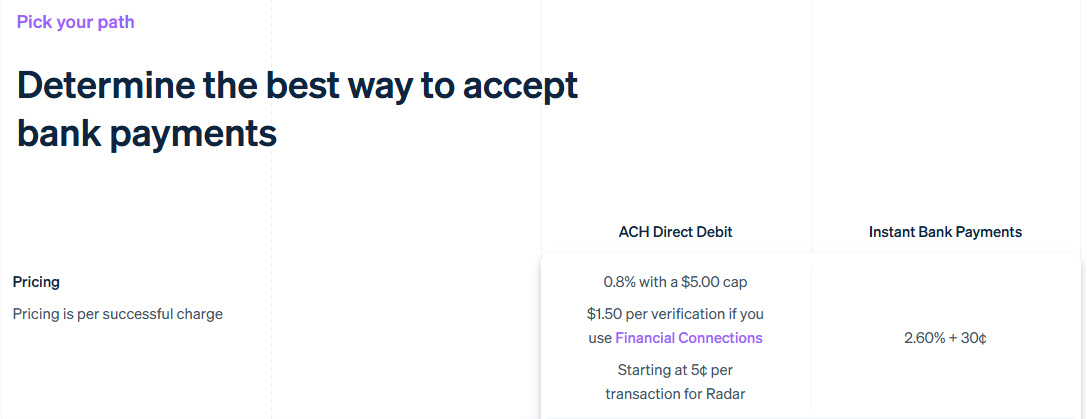
| Collection setup | $500 payment | $1,000 payment | $2,000 payment |
|---|---|---|---|
| Stripe ACH processing only | $4.00 | $5.00 | $5.00 |
| Stripe ACH plus Invoicing Starter | $6.00 | $9.00 | $13.00 |
| PayPal basic invoice, Pay by Bank | $5.00 | $10.00 | $10.00 |
For the complete invoice setups, Stripe costs $1 less at $1,000 but $3 more at $2,000. “Stripe caps ACH at $5” is therefore not enough information to price a large invoice.
Stripe also lists $1.50 per Financial Connections verification when that option is used. Include it where applicable, but do not charge it again on every recurring collection unless another verification occurs. See the bank-payment cost breakdown.
PayPal’s separate ACH Services product is also listed at 0.8%, capped at $5, but is not the invoice Pay by Bank product. Check its eligibility in the Online Payment Services schedule.
Bank debit requires an appropriate authorization and payment flow. Confirmation, settlement, and possible returns differ from card checkout; review Stripe’s ACH documentation before treating a lower fee as an otherwise identical replacement.
Subscription fees: compare the collection and billing service together
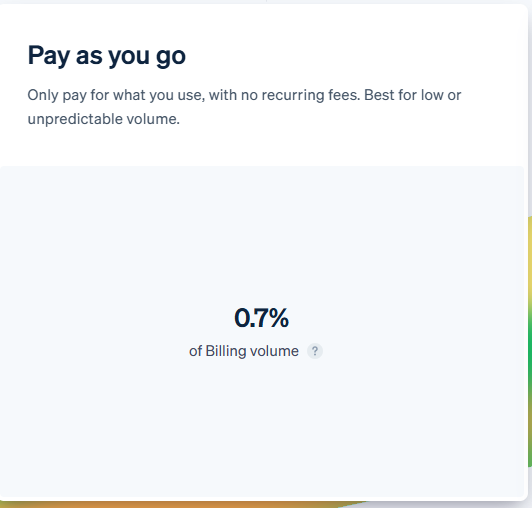
Stripe Billing’s pay-as-you-go plan charges 0.7% of Billing volume, in addition to payment processing. Billing volume includes relevant transactions processed on and off Stripe and excludes one-off invoices. Its pay-monthly plans instead involve annual commitments, volume allowances, and overages. Compare the actual plan using Stripe Billing pricing, rather than adding both pricing models together.
PayPal’s advertised recurring-payment offering lists $0 setup and monthly fees, with 3.49% + $0.49 per domestic USD transaction. This is a specific subscription setup, not a claim that every PayPal recurring tool has identical pricing.
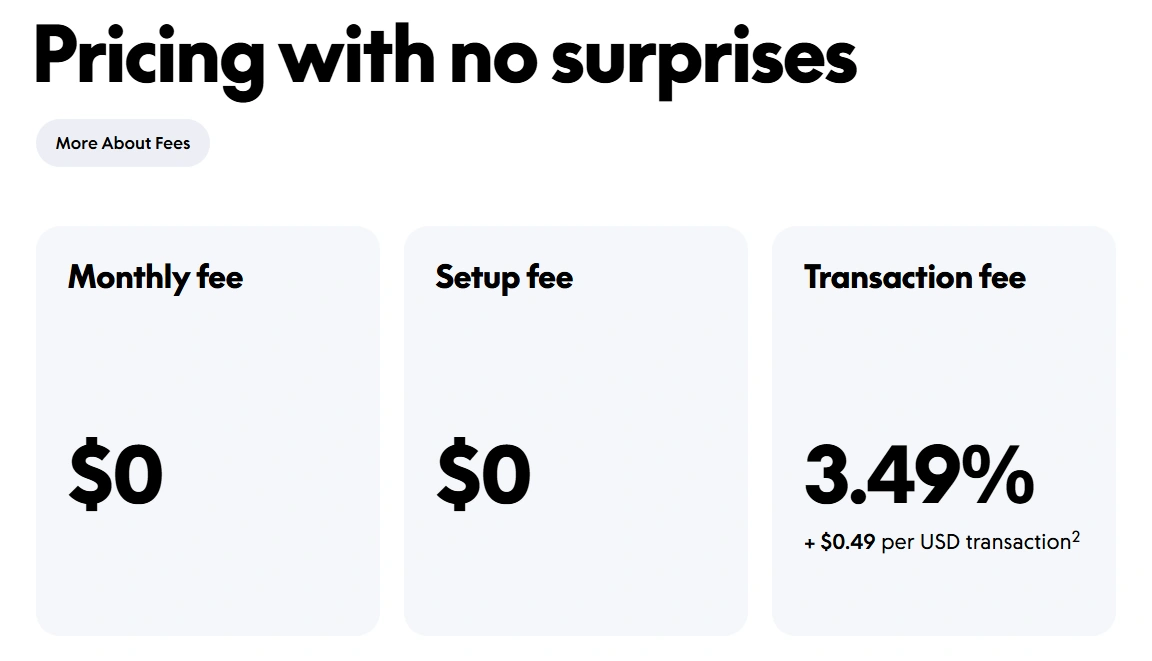
For a simple recurring charge, compare Stripe’s domestic card processing plus pay-as-you-go Billing with that PayPal recurring-payment offering:
$50 charge: Stripe costs $1.75 for processing plus $0.35 for Billing, totaling $2.10. PayPal costs $2.24 after rounding.
$500 charge: Stripe costs $14.80 plus $3.50, totaling $18.30. PayPal costs $17.94.
The lower-cost choice changes with the charge amount. These examples exclude tax software, additional subscription-management tools, conversion, and failed-payment costs; they do not establish feature parity.
Do not add Stripe’s one-time Invoicing percentage to subscription invoices already covered by Billing. Also distinguish an automatically sent invoice from an authorized automatic payment. Stripe’s invoicing guidance separates those pricing categories, while PayPal’s recurring product supports automated collection.
In-person fees: Stripe Terminal versus PayPal POS
For domestic card-present payments, compare reader processing separately from phone-based Tap to Pay. Stripe adds a per-authorization charge for Tap to Pay.
| In-person setup | Standard processing | Cost on a $50 sale |
|---|---|---|
| PayPal POS, card present | 2.29% + $0.09 | $1.24 |
| Stripe Terminal, card reader | 2.7% + $0.05 | $1.40 |
| Stripe Terminal, Tap to Pay | 2.7% + $0.05, plus $0.10 per authorization | $1.50 |
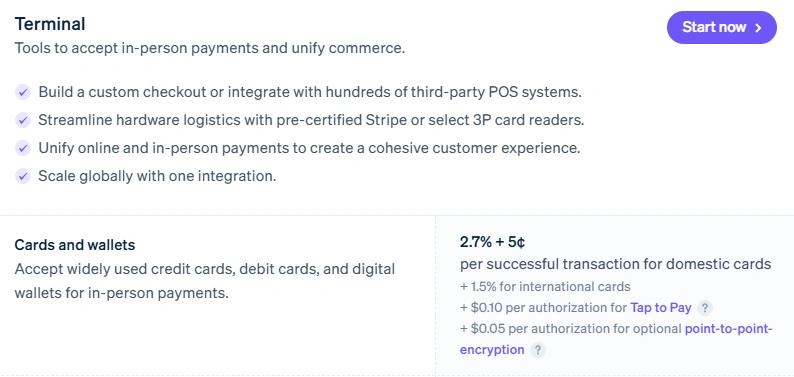
PayPal costs $0.16 less than the Stripe reader setup and $0.26 less than Stripe Tap to Pay in this example. Compare those ongoing costs with the devices and software your business actually requires.
For reader transactions, the unrounded fees cross at approximately $9.76: ($0.09 − $0.05) ÷ (0.027 − 0.0229). Below that amount, Stripe’s lower fixed charge can outweigh its higher percentage; rounding creates ties around the crossover. The calculation does not include Stripe’s separate Tap to Pay authorization charge.
Manually entering a card is another payment channel. Do not apply these card-present prices to remote orders, dashboard-keyed payments, or Virtual Terminal. PayPal lists manual POS entry separately, while Stripe’s card pricing identifies its manually entered-card addition.
International fees: separate cross-border processing from conversion
For a US Stripe account, standard online card pricing adds 1.5 percentage points for an international card. PayPal’s relevant flat-rate receiving products add 1.50 percentage points for an international transaction. Stripe’s card classification and PayPal’s account-market definitions are not interchangeable. Check Stripe’s card supplements and PayPal’s international rules.
For a $100 USD payment to a US business, with a UK-issued card in the Stripe scenario or the applicable UK customer/payment conditions in the PayPal scenario, and no conversion in the receiving calculation:
Stripe online card: $4.70.
PayPal advanced card processing, flat rate: $4.68.
PayPal wallet Checkout: $5.48.
Those are processing-only estimates. Stripe separately lists an additional 1% when processing currency conversion is required. PayPal uses a transaction exchange rate containing the applicable conversion spread. See Stripe’s conversion condition and PayPal’s exchange-rate explanation.
Compare the actual amount that reaches the merchant in the same settlement currency. Do not add PayPal’s spread again after applying a quote that already includes it, or treat buyer-paid conversion and merchant conversion as the same cost. Local-currency presentation and multi-currency settlement options need their own pricing check.
Refunds, disputes, and payouts can change the total
Refunded sales retain processing costs
Stripe does not return the original processing fees on ordinary refunded payments under standard pricing. PayPal likewise retains the original receiving fee when a goods-and-services payment is refunded, although issuing that refund has no new fee. Check Stripe’s refund documentation and PayPal’s refund guidance for the applicable product.
For the $100 online example, refunding the full sale leaves the original $3.20 Stripe card fee, $3.18 PayPal advanced-card fee, or $3.98 PayPal-wallet fee unrecovered. That is a retained cost—not the same fee charged a second time.
A dispute is not one universally refundable fee
For standard US card disputes, Stripe lists $15 when a dispute is received and another $15 when it is manually countered. The countered fee is returned if you win; the received fee is not refundable for US businesses. Sources: Stripe’s US dispute prices, its dispute-fee FAQ, and the dispute rules.
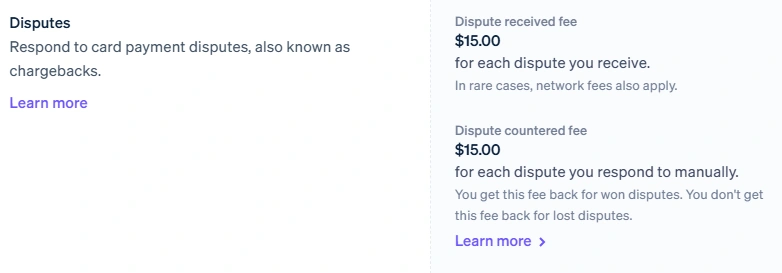
For an ordinary manually challenged case, that means $15 in those fees after a win or $30 after a loss, excluding the disputed principal, original processing cost, and any exceptional network charge. Optional Smart Disputes uses a different charging arrangement; Stripe’s countered-fee guidance excludes responses it submits through that service from the manual countered fee.
PayPal lists $15 standard dispute fees, $30 high-volume dispute fees, and $20 chargeback fees in its USD schedule. These are different categories, not three charges to add automatically to one case.
PayPal’s applicable route and waivers matter. Its User Agreement distinguishes account and guest-checkout disputes from chargebacks on other card-payment routes. Standard dispute-fee exemptions are not identical to high-volume or chargeback rules. Compare the event you expect to handle rather than declaring one provider cheaper from a single chargeback number.
Instant merchant payouts have similar headline pricing
For the US direct-merchant scenarios covered here, both Stripe Instant Payouts and PayPal business instant transfers charge 1.5%, with a $0.50 minimum. Eligible standard bank payouts or withdrawals have no provider transfer fee without the additional currency or service conditions discussed above. Sources: Stripe payout pricing, Stripe eligibility, and PayPal business withdrawals.
An instant transfer of an existing $1,000 available balance therefore has a modeled $15 fee with either provider. Apply that percentage to the amount transferred, not automatically to the original sales total. Payment confirmation, available funds, and bank arrival are separate stages; an instant-transfer option does not guarantee access to money that is still unavailable.
What would each setup cost on $20,000 per month?
Monthly volume alone is not enough to calculate fees. You also need transaction count, average payment amount, and the product used. Start with a controlled example: 200 successful domestic $100 online payments, all through the named route, with no additional software or event costs.
| Modeled payment setup | Monthly processing fees | Effective processing rate |
|---|---|---|
| Stripe standard online cards | $640.00 | 3.20% |
| PayPal standard cards | $696.00 | 3.48% |
| PayPal advanced cards, flat rate | $636.00 | 3.18% |
| PayPal wallet Checkout | $796.00 | 3.98% |
Stripe saves $56 against PayPal standard cards and $156 against the all-wallet scenario. It costs $4 more than PayPal’s advanced-card setup. Increasing volume does not automatically reverse the order when the applicable rates remain unchanged.
Now split the same $20,000 into 400 payments of $50. Stripe’s processing total becomes $700, rather than $640, because there are 200 additional fixed charges. A comparison that names only monthly volume can miss that difference.
Build your own complete monthly comparison
Use a representative month of actual transactions and apply:
Total payment costs = transaction fees + applicable software charges + recurring services + included event and payout costs
Use the full amount charged for each payment, including any shipping or tax already collected within it, rather than adding those amounts twice. Calculate caps, minimums, and rounding at the appropriate transaction stage.
Keep equipment and migration expenses in a separate first-period total. Do not count a retained processing fee twice after a refund, or classify refunded principal and reserved funds as processing charges. Apply any contracted pricing instead of the public rates used here.
For an effective processing rate, divide included processing fees by the corresponding gross payment volume. If you include software and other costs too, label the result as a broader payment-cost measure. Small fee differences should be weighed against your actual switching expense—not an invented estimate of development hours or increased sales.
Can you offer PayPal and Stripe together?
Separate integrations and PayPal processed through Stripe are different arrangements. Stripe’s native PayPal payment-method documentation lists supported merchant locations in Europe and the UK; it does not list the United States. A US business should verify its platform or separate-integration options rather than assume that native method can simply be enabled.
With separate direct integrations, calculate the fees on payments routed to each provider. Do not charge both providers’ processing fees to every sale.
For example, 120 domestic $100 card payments through Stripe cost $384. Another 80 domestic $100 wallet payments through PayPal cost $318.40. Combined processing is $702.40 on $20,000 received, before shared software or other services.
That is different from assuming all 200 payments will move to Stripe cards. Model the payment mix you can reasonably support, and check any platform charges or billing software that remains payable across both providers.
Which is cheaper for your business?
For straightforward online card processing, compare Stripe with both PayPal card products. Stripe is cheaper than the standard-card setup in the examples, while PayPal advanced-card processing has a slightly lower published rate. Check eligibility, integration responsibilities, and existing costs before switching for a small difference.
For client invoices, include invoicing software and the customer’s payment method. The $1,000 card-paid PayPal invoice beats Stripe Invoicing Starter here, but a wallet-paid PayPal invoice does not. Bank-paid invoice costs can change order as payment amounts encounter different caps.
For subscriptions and in-person sales, compare the complete setup. Stripe Billing adds a separate charge, while its Terminal and Tap to Pay routes have different costs. The recurring-payment and POS examples show why a general online-processing verdict cannot answer those decisions.
The useful choice is the eligible setup that costs less for your actual payment mix while providing the collection, billing, and operational capabilities you need. Use the linked product schedules and your own transaction counts to make that decision—not one headline percentage.
Last verified: October 18, 2026.